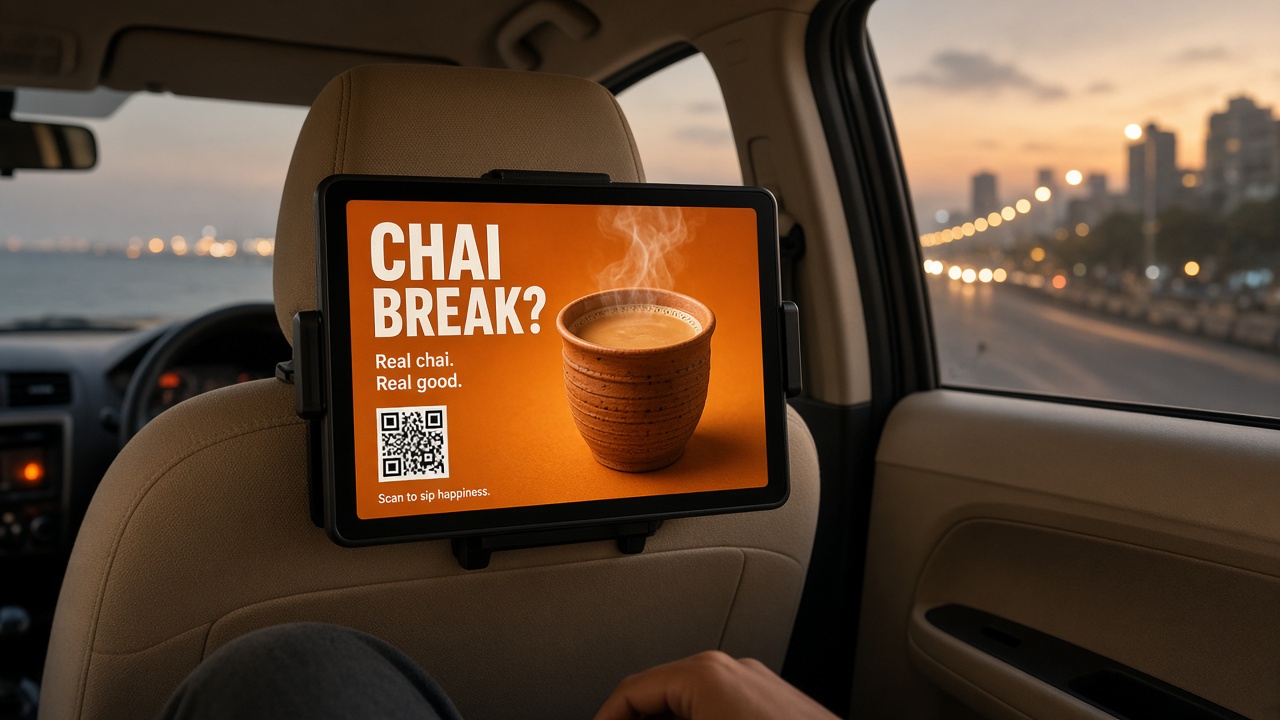
Direct answer. Digital takes most of India's ad budget, yet OOH is the only traditional medium still growing. Here's how to split spend between outdoor and digital in Mumbai, Delhi NCR and Bengaluru.
Every marketing plan in India now starts with the same question: how much goes to digital, and is there any reason left to buy outdoor?
The numbers seem to settle it. Digital takes the majority of Indian ad spend and keeps growing. Yet the same industry reports that crown digital also point to something most planners skip past: outdoor is the only traditional medium that is still growing.
So the real question isn't "outdoor or digital". It's what each one does best in a metro, and how to make them work together. This guide covers the data, the trade-offs and a practical way to split a budget across Mumbai, Delhi NCR and Bengaluru.
In this article
- What the 2026 numbers say
- What digital does better
- What outdoor does better
- Why metros change the maths
- Outdoor is no longer one thing
- A practical way to split your budget
- How to measure both on one scorecard
- FAQs
What the 2026 numbers say
Three major industry reports published in 2026 agree on the overall direction.
- The dentsu-e4m Digital Advertising Report 2026 puts digital at ₹71,621 crore, or 59% of the Indian ad market. It expects OOH to grow at a 3% compound annual rate and reach a 4% share by 2027. It credits digital OOH networks, modernised transit infrastructure and demand for high-impact urban visibility.
- The Pitch Madison Advertising Report 2026 projects total ad spend of ₹1,74,605 crore in 2026, with digital's share rising from 60% to 64% under its expanded definition. The same report calls OOH the only traditional medium growing in aggregate. It recommends planning OOH as part of an "Integrated Attention System" alongside large screens and digital video.
- WPP Media's This Year Next Year mid-2026 forecast expects OOH to grow 8.6% to $0.5 billion on the back of infrastructure and transit expansion. It also notes that digital OOH is still less than 5% of that total.
Each report defines the market differently, so the headline figures don't match. The direction does: digital is the default, and outdoor is the one traditional channel that brands are still adding to. That only happens when a medium does something the default can't.
What digital does better
Credit where it's due. Digital wins on four things:
- Targeting by intent and identity. Search catches people who are already looking. Social reaches people by interest, behaviour and lookalike audiences.
- Instant response. A tap takes someone straight to a page, a cart or a lead form.
- Fast iteration. You can swap creatives, budgets and audiences in minutes.
- Granular reporting. Clicks, conversions and cost per result arrive without much effort.
If your product is bought on impulse online and your unit economics work on paid social, digital should carry most of your budget. Nobody is arguing otherwise.
What outdoor does better
Digital's weaknesses are the flip side of its strengths.
Attention is contested. Every digital ad competes with the feed, the notification, the skip button and the next swipe. Nielsen Norman Group's eyetracking research shows that people learn to ignore anything that looks like an ad. We cover this in depth in Display Advertising Explained: Banner Ads vs In-Transit Digital Screens.
Costs rise when everyone bids for the same audience. In metros, the people most brands want are the same people every other brand is bidding for.
Physical presence builds trust. Seeing a brand in the real world, in the places where you live and work, tells you the business is established.
Outdoor answers each of these. It isn't skippable, it doesn't run in an auction, and it puts the brand in the customer's physical world. The traditional catch was that outdoor was hard to target, hard to change and almost impossible to measure. That catch is weakening, as the next sections show.
Why metros change the maths
Metros reward outdoor for three reasons.
1. Commutes are long. A big share of a metro professional's day happens in transit, and Backseat Network plans its in-cab screens around rides of 20 to 45 minutes. That's a long stretch where the customer is not at a desk and often not scrolling.
2. Audiences cluster. Finance in BKC and Lower Parel. Corporate Gurugram around Cyber City. Tech workers on Bengaluru's Outer Ring Road. In a metro, where someone travels tells you a lot about who they are. Our Mumbai, Delhi NCR and Bengaluru pages show where our fleets operate.
3. Airports carry high-value travellers in volume. Mumbai's Chhatrapati Shivaji Maharaj International Airport handled about 55.5 million passengers in 2025, a record for the airport. Every one of those trips starts or ends with a ride into the city. See how to plan an airport cab campaign in Mumbai.
Outdoor is no longer one thing
"Outdoor" covers formats that behave very differently. Treating hoardings, cab wraps and in-cab screens as one line item is how outdoor ends up looking unmeasurable.
| Hoardings | Cab wraps and auto branding | In-cab screens | |
|---|---|---|---|
| Time with the ad | Seconds while passing | Seconds while passing | The whole ride, looping |
| Viewing distance | Far, a glance | Street level | About 60 cm, eye level |
| Call to action | Hard to act on | Hard to act on | QR code during the ride |
| Proof of delivery | Site photos | Vehicle photos | Counted plays and a live GPS map |
| Changing creative | Reprint and remount | Re-wrap or reprint | Upload, review, go live |
| Smallest buy | One site, often for months | Several vehicles | 1 cab for 1 month |
Source: Backseat Network format comparison. Dwell time and viewing distance are Backseat Network planning figures for its own screens.
Hoardings are still the right tool for big, fast, city-wide awareness. In-cab screens do a different job: they give you a long stretch of attention from one passenger, a way for that passenger to act, and proof that the ad ran. That's why in-cab works as a bridge between outdoor and digital. If the format is new to you, start with What is in-cab advertising (CADOOH) in India?.
A practical way to split your budget
There is no universal ratio. Anyone who gives you one without asking about your business is guessing. A better approach is to decide the split by the job each rupee has to do.
Step 1: Match the channel to the job
| Job to be done | Lead with | Support with |
|---|---|---|
| Capture people already searching | Search ads | Retargeting |
| Generate demand for a new category | Video and social | In-cab screens in target cities |
| Reach senior B2B buyers | LinkedIn, events | Airport and business-district cab screens |
| Build local trust for a city launch | In-cab screens and hyper-local outdoor | Location-targeted social and search |
| Mass awareness for a big launch | TV, CTV, hoardings | Digital video |
Step 2: Run outdoor as a test, not a bet
Outdoor used to require big minimum buys. That made testing impossible. In-cab changes this. Backseat Network's minimum booking is one cab for one month at ₹4,000 plus GST, the same rate in every city. A useful first test:
- One city where your sales team can follow up
- 10 cabs for 1 month: ₹40,000 media + ₹7,200 GST = ₹47,200 (see the calculator)
- One message, one QR code, one landing page
- Set the success metric before launch: cost per lead or order compared with your paid social benchmark
Step 3: Scale what the data supports
If in-cab beats your social cost per result in a city, extend to 3 months and add cabs. A 10-cab, 3-month plan in Mumbai costs ₹1,41,600 including GST and projects 3,60,000 plays. That's about ₹333 per 1,000 plays, based on average vehicle activity rather than a guarantee. If it doesn't beat your benchmark, change the message or the city before you drop the channel.
Step 4: Make the channels feed each other
- Use the same headline in the cab and on the landing page.
- Retarget in-cab visitors on social, using the UTM-tagged traffic as a seed audience.
- Run location-targeted search in the cities where your cabs run, to catch the people who saw the ad and searched later. More on this in Targeted Advertising in the Real World.
How to measure both on one scorecard
Outdoor loses budget battles because it reports in photos while digital reports in conversions. Put both on the same scorecard.
| Metric | Digital source | In-cab source |
|---|---|---|
| Delivery | Platform impressions | GPS-logged plays in the Backseat console |
| Response | Clicks | QR scans via UTM-tagged links |
| Conversion | Analytics and CRM | Same analytics and CRM, own source |
| Cost per result | Spend ÷ conversions | Spend incl. GST ÷ conversions |
| Halo | Branded search | Branded search in campaign cities |
Tag every QR link the way Google Analytics recommends, with utm_source, utm_medium and utm_campaign. For example: utm_source=backseat&utm_medium=incab&utm_campaign=mumbai-q1. In-cab traffic then appears as its own source next to Meta, Google and email.
One limitation, stated plainly: plays are counted playouts, not verified unique viewers. Treat plays as proof of delivery, and scans and conversions as proof of response.
The bottom line
Digital should carry most metro budgets, and it does. The brands that grow fastest, though, aren't the ones spending the most on digital. They're the ones buying attention where the auction isn't.
In a metro, a lot of that attention sits in the back seat of a cab: 20 to 45 minutes, a screen at eye level, and a QR code within reach.
Start small. Price a one-city test, or book a 20-minute walkthrough with our team.
FAQs
Is outdoor advertising still worth it when digital takes most of the budget?
Yes, for the right jobs. Industry reports from dentsu-e4m and Pitch Madison both identify OOH as the only traditional medium still growing in India. Outdoor works best for building physical presence, reaching audiences in specific places, and getting attention without an auction. Digital stays stronger for intent capture and instant response.
What is the minimum budget to test in-cab outdoor advertising in a metro?
On Backseat Network, the minimum booking is one cab for one month at ₹4,000 plus 18% GST. For a test you can make a decision from, many brands start with around 10 cabs in one city for a month, which costs ₹47,200 including GST.
How is in-cab advertising different from a hoarding?
A hoarding is seen at a distance for a few seconds by people passing by. An in-cab screen sits about 60 cm from one passenger at eye level and loops for the whole ride, typically 20 to 45 minutes. It includes a QR code for immediate action, and every play is logged with GPS.
Can outdoor advertising be measured like digital ads?
Digital formats like in-cab screens can come close. Plays are logged with GPS location. QR codes with UTM-tagged links send scans into your own analytics as a separate source, and conversions are tracked the same way as any digital channel. Traditional static hoardings still rely mostly on site photos.
Which metro should I start with?
Start in the city where your customers are concentrated and where your sales or delivery team can follow up quickly. Backseat Network is live in Mumbai, Delhi NCR and Bengaluru, with Hyderabad, Chennai and Pune onboarding. Pricing is the same in every city, so choose based on strategy, not rate.
Should B2B brands use outdoor advertising?
B2B brands can benefit most from targeted outdoor formats. Airport cabs and business-district routes carry business travellers and professionals on long rides. That's a hard audience to get uninterrupted time with on digital channels.
Related reading
Put this on a cab this week
₹4,000 per cab per month plus GST. Build the ad yourself, or book a 15-minute demo.