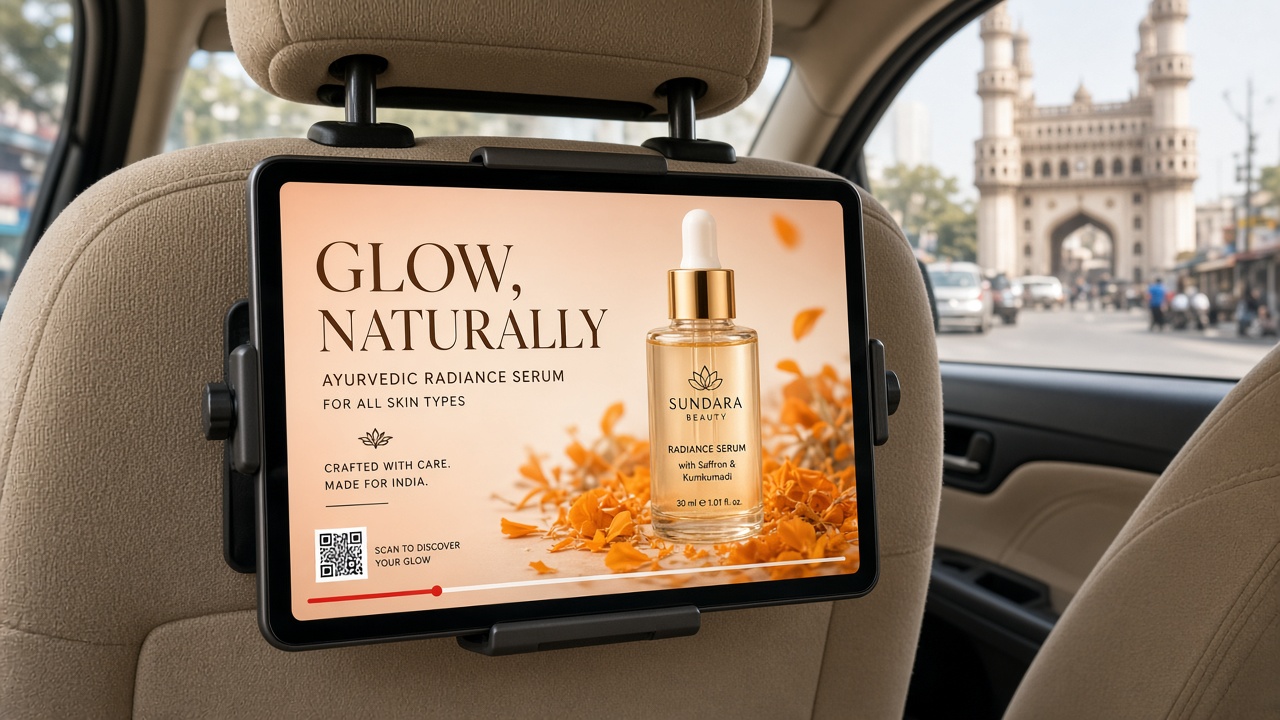
Direct answer. Banner ads are cheap to buy and easy to ignore. In-transit screens trade auction targeting for attention. Here's how display advertising works in both, and when to use each.
"Display advertising" used to mean one thing: a rectangle on a web page. Today it covers everything from a 300x250 banner on a news site to a full-screen video on the tablet behind a cab driver's headrest.
Both are visual ads on a screen. Both are bought digitally. But they behave very differently, because the person looking at them is in a completely different state of mind.
This guide explains how each format works, why banner ads get ignored, where in-transit screens fit, and how to decide which one deserves your next rupee.
In this article
- What display advertising means today
- How banner ads work
- The banner blindness problem
- How in-transit digital screens work
- Head-to-head comparison
- Creative: what works on each
- When to use which
- FAQs
What display advertising means today
Display advertising is any paid visual ad, made of image, video or text, shown in a placement next to content rather than in search results. It falls into two broad families:
- Online display: banners, native ads and video units on websites and apps, mostly bought programmatically through ad networks and exchanges.
- Digital out-of-home (DOOH): screens in physical places such as malls, airports, metro stations and vehicles, showing ads in a loop.
In-transit digital screens are a type of DOOH placed inside vehicles. In India this includes cab screens, sometimes called CADOOH (cab digital out-of-home). If the term is new to you, read What is in-cab advertising (CADOOH) in India? first.
How banner ads work
A banner ad is a placement on a web page or in an app, usually in standard sizes. Most are bought through programmatic auctions:
- A user loads a page.
- The publisher's ad server offers the impression to buyers.
- Advertisers bid based on who the user is, where they are and what they've done.
- The winning ad loads in milliseconds.
Strengths
- Targeting by audience, interest, behaviour, retargeting lists and location
- Huge scale at low cost per impression
- Click-through to a landing page
- Detailed, automatic reporting
Weaknesses
- Competes with the content the user actually came for
- Sits in positions people have learned to skip
- Easy to block, scroll past or close
- Viewability and fraud need extra checks
The banner blindness problem
The biggest problem with banners isn't price or targeting. It's attention.
Nielsen Norman Group, the UX research firm, has studied this for decades. Its eyetracking research shows banner blindness is still widespread. It describes it as a form of selective attention: people focus only on what serves their goal, and ads usually don't. Its studies found that users ignore elements that look like ads because of:
- Location: ad-specific spots like the top of the page or the right rail
- Visual treatment: animation and other ad-like styling
- Proximity: sitting near other ads or promotions
The firm notes that ignoring ads is a learned behaviour. Every year people spend online, they get better at it.
This matters for planning. A banner can be "served" and "viewable" by industry standards and still never be looked at. That cost doesn't show up in your dashboard.
How in-transit digital screens work
An in-transit screen sits inside a vehicle, facing the passenger. On Backseat Network, it works like this (full flow here):
- Placement: a tablet on the headrest behind the driver, about 60 cm from the passenger, at eye level
- Playback: silent, full screen, on a loop, with no skip button
- Dwell time: rides planned at 20 to 45 minutes; airport rides average about 45
- Rotation: each spot is about 15 seconds by default and loops with other brands' creatives
- Action: every creative carries a QR code, so the passenger can scan during the ride
- Proof: each tablet logs every play with GPS position, and the console shows a live map (measurement details)
Targeting works differently from banners. You don't bid on individual users. You choose the city, the cab type (airport MUVs for premium travellers, city sedans for frequency), the number of cabs and the number of months. Reports then show plays and reach by city and route, and QR scans by creative.
The trade-off is clear. You give up per-person targeting. In return you get a setting with almost no competing content and a viewer with time to spare.
Head-to-head comparison
| Banner ads | In-transit digital screens (in-cab) | |
|---|---|---|
| Where the viewer is | Reading, scrolling, working | Sitting in a cab, often with nothing to do |
| Competition for attention | The content, other ads, notifications | Very little inside the cabin |
| Time on screen | Often a fraction of a second | Loops for a 20 to 45 minute ride |
| Distance | Phone or laptop | About 60 cm, eye level |
| Skippable or blockable | Yes, often | No skip, no ad blocker |
| Sound | Often muted | Silent by design |
| Targeting | Person-level, auction-based | City, cab type, cab count, months |
| Response path | Click | QR scan |
| Proof of delivery | Platform impressions, viewability vendors | GPS-logged plays, live map |
| Pricing | Auction, varies by audience | Flat: ₹4,000 per cab per month + GST (pricing) |
| Minimum buy | Any budget | 1 cab for 1 month |
Neither format is better across the board. They're built for different jobs.
Creative: what works on each
Banners
- Keep it simple: one offer, one button
- Make sure it doesn't look like every other ad on the page
- Make it relevant to the page it appears on
- Test lots of variants, because the auction rewards the winners
In-transit screens
The rules change when the screen is silent and the viewer has time. Backseat Network's format guidelines recommend:
- Landscape MP4 of about 15 seconds, or a JPG, PNG or WebP still, up to 40 MB
- No sound. All meaning carried by visuals and text
- Roughly 6 to 14 words in large type, in Hindi, English or both
- Type readable in two seconds, with one message and one visual
- One large, high-contrast QR code
Two creative principles follow from the format:
- Repetition is free. Your spot loops through the ride, so you don't need to say everything in one pass. One clear idea repeated beats five ideas crammed together.
- Give a reason to scan. "Scan for 20% off your first order" or "Scan to book a demo" works. A bare QR code doesn't.
No in-house design team? Vira, Backseat Network's AI creative tool, can draft a bilingual landscape cab ad from your website, which you then edit and approve.
When to use which
Use banner ads when:
- You need to reach specific people by behaviour or retargeting lists
- Your goal is a click to a product page, and you'll optimise to conversion data
- You need national scale at a low cost per impression
Use in-transit screens when:
- Your message needs more than a glance, for example a new category, a B2B product or a considered purchase
- You want to reach people in specific cities and routes, such as business travellers in airport cabs
- You need brand safety: every creative is reviewed before it plays, and there's no risky page content next to your ad
- You want outdoor-style presence with digital-style measurement
Use both together: run in-cab screens in your launch city, and point their QR codes to a UTM-tagged landing page following Google Analytics' guidelines. Then use that traffic to build retargeting audiences for your banners. The cab screen does the explaining. The banner does the reminding.
For a fuller budget framework, see Outdoor Advertising vs Digital Ads: Where Should You Spend in Metros?
A note on honest measurement
Comparing the two formats fairly means being careful with terms.
- A banner "impression" means the ad was served. Viewability standards add another layer on top of that.
- An in-cab "impression" on Backseat Network means a counted playout on a screen, logged with GPS. It isn't a verified unique viewer.
Neither number tells you if a human paid attention. That's why the most reliable comparison is further down the funnel: cost per scan or click, cost per lead and cost per sale, measured in the same analytics tool. For an industry view of DOOH measurement, the IAB DOOH Measurement Guide (July 2025) is a useful reference.
The bottom line
Banner ads won the internet by being cheap, targetable and measurable. They also taught a generation of users to ignore them.
In-transit screens flip the equation: less precise targeting, far more attention. The smart plan isn't choosing one. It's giving each format the job it does best.
Try the other side of display. See formats and specs, or launch a campaign from one cab.
FAQs
What is the difference between display advertising and DOOH?
Display advertising usually means visual ads on websites and apps, such as banners and video units. Digital out-of-home (DOOH) means digital screens in physical places, such as airports, malls and vehicles. In-transit screens inside cabs are a form of DOOH.
What is banner blindness?
Banner blindness is people's learned habit of ignoring parts of a web page that look like ads. Nielsen Norman Group's eyetracking studies link it to ad-typical placement, ad-like visual styling such as animation, and closeness to other ads.
Are in-cab screen ads skippable?
No. On Backseat Network, the headrest screens play silently, full screen, on a loop, with no skip button. Your spot plays in rotation with other brands' creatives throughout the ride.
How do you target ads on in-transit screens?
Instead of bidding on individual users, you choose the city, the cab type (airport cabs or city cabs), the number of cabs and the number of months. Reports show plays and reach by city and route, and QR scans by creative, so you can move budget to what performs.
What creative format do in-cab screens need?
A silent landscape MP4 of about 15 seconds, or a JPG, PNG or WebP still, up to 40 MB, with a large QR code. Use about 6 to 14 words in large type, readable in two seconds. Every creative is reviewed before it goes live.
Can I run banner ads and in-cab screens together?
Yes, and it often works better than either alone. Use in-cab screens to explain your product to people in a target city. Send QR scans to a UTM-tagged landing page, then retarget those visitors with banner and social ads.
Related reading
Put this on a cab this week
₹4,000 per cab per month plus GST. Build the ad yourself, or book a 15-minute demo.