Direct answer. India's transit networks are expanding and outdoor is going digital. Here's where transit advertising is heading, from bus wraps and moving billboards to in-cab screens, programmatic buying and real measurement.
Transit advertising is one of the oldest ideas in marketing: put your message where people travel. Painted trams, printed bus panels and ads on the side of trains were around long before the internet.
What's changing now isn't the idea. It's the infrastructure underneath it. Indian cities are building transit at a pace they never have before. Screens are replacing printed panels. And buyers who are used to digital dashboards are asking outdoor for the same proof.
This guide looks at where transit advertising in India is heading: the formats, the trends driving them, and what brands should do about it in the next 12 to 24 months.
In this article
- Why transit advertising is growing again
- The transit formats, compared
- Bus wraps: reach at street level
- Moving billboards: mobile and flexible
- Cab screens: attention inside the vehicle
- Six trends shaping what comes next
- What brands should do now
- FAQs
Why transit advertising is growing again
Three forces are pushing transit media forward in India.
1. The networks are getting bigger
According to a Press Information Bureau factsheet, India's operational metro network grew from 248 km in 2014 to about 1,095 km in 2025. It now runs across 26 cities, making it the third-largest operational metro network in the world. Airports are busier too: Mumbai's CSMIA handled about 55.5 million passengers in 2025, its highest ever. More journeys mean more transit inventory and more time people spend travelling.
2. Outdoor is the traditional medium that's still growing
WPP Media's mid-2026 forecast expects Indian OOH to grow 8.6% to $0.5 billion, driven by infrastructure and transit expansion. The dentsu-e4m report links OOH's growth to digital OOH networks, modernised transit infrastructure and demand for high-impact urban visibility.
3. Outdoor is going digital, unevenly
An EY report covered by exchange4media estimates India has around 1,85,000 DOOH screens. It expects digital OOH to reach 17% of outdoor revenues by 2027. WPP Media puts the current digital share of OOH below 5%. The two estimates use different definitions, but they agree on the direction: most Indian outdoor is still printed, and the shift to digital has a long way to go.
The transit formats, compared
"Transit advertising" covers very different formats. Here's how the main ones compare on what matters to a buyer.
| Bus wraps | Moving billboards (LED and branded vans) | Cab wraps and auto branding | In-cab screens | |
|---|---|---|---|---|
| Who sees it | People on the street and in traffic | People on the street | People on the street | The passenger inside |
| Time with the ad | Seconds while passing | Seconds to minutes, depending on route | Seconds while passing | The whole ride, looping |
| Interaction | Hard to act on | Hard to act on | Hard to act on | QR code during the ride |
| Changing creative | Re-wrap | Fast on LED, slow on print | Re-wrap or reprint | Upload, review, go live |
| Proof of delivery | Photos, route plans | Photos, GPS on some vehicles | Vehicle photos | Counted plays, live GPS map |
| Best for | Mass visibility on fixed routes | Launches, events, targeted routes | Volume of moving presence | Attention, response, measurement |
In-cab figures are from Backseat Network's comparison page. Other formats vary by operator.
Bus wraps: reach at street level
A full bus wrap is one of the largest moving surfaces in a city. It runs on fixed routes through dense areas and can't be skipped from the street.
Where it's strong: mass awareness on predictable routes, especially for brands that want to look big in a city.
Where it's limited: viewers see it in passing, there's no easy way to respond, creative changes mean a re-wrap, and proof usually means photographs and route schedules.
What's likely to change: expect more digital screens inside buses, and better route data so buyers can plan by corridor rather than by depot.
Moving billboards: mobile and flexible
Moving billboards range from printed branded vans to trucks with LED screens. Their advantage is flexibility: you can send them to an event, a mall launch or a specific neighbourhood.
Where they're strong: launches, events, and short bursts in chosen areas.
Where they're limited: cost per vehicle, permissions that vary by city, and short exposure. Some Indian cities also restrict video on outdoor screens. The EY-cited coverage notes that driver distraction is one of the concerns behind those rules.
That last point matters for the whole category. Screens that face drivers raise safety questions. Screens that face passengers don't.
Cab screens: attention inside the vehicle
Cab screens solve the problem every street-facing format shares: the viewer is moving past.
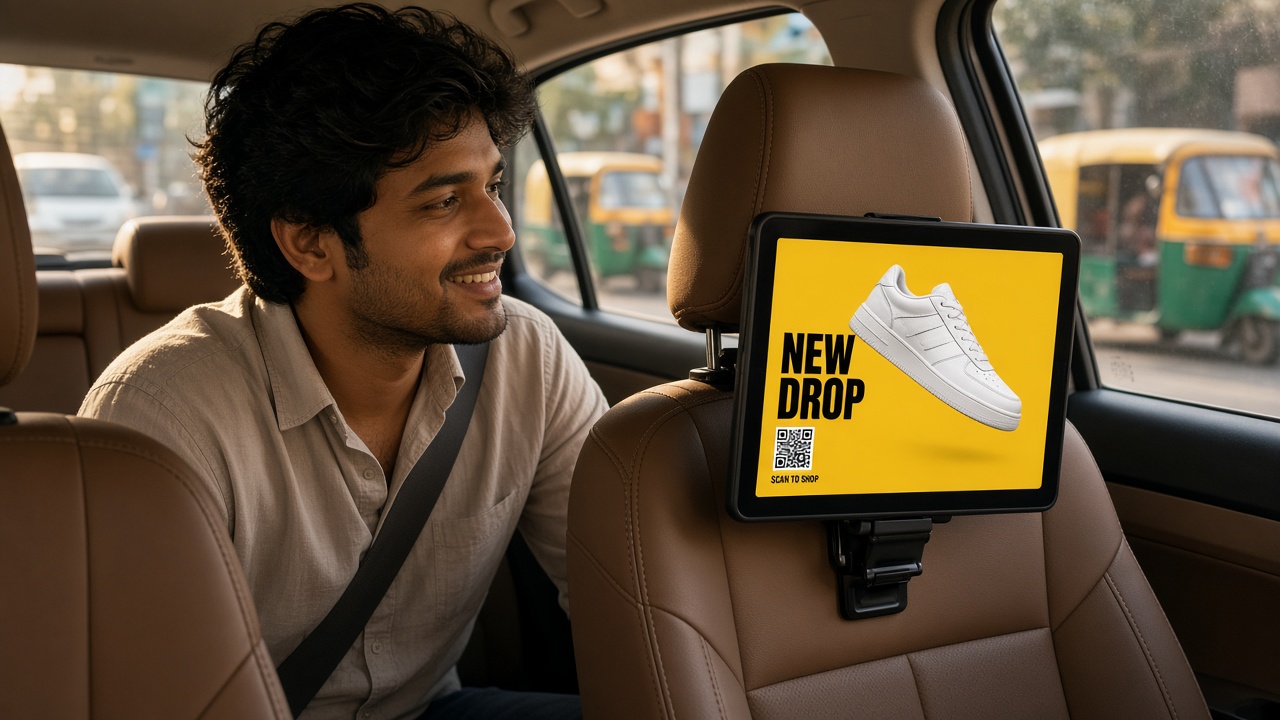
On Backseat Network:
- The screen is a tablet on the driver's headrest, about 60 cm from the passenger, at eye level
- It plays silently, full screen, on a loop, with no skip button
- Rides are planned at 20 to 45 minutes, and airport rides average about 45
- Every creative carries a QR code, so the passenger can act during the ride
- Every play is logged with GPS, with a live map in the console (measurement)
- Pricing is flat: ₹4,000 per cab per month plus GST, from one cab for one month (pricing)
Because the screens face passengers and play silently, they avoid the driver-distraction concerns linked to street-facing video. Every creative is also reviewed before it plays.
Backseat Network is live in Mumbai, Delhi NCR and Bengaluru, and onboarding Hyderabad, Chennai and Pune. Its stated goal is 50,000 vehicles across India. Its fleet mix also includes two-wheelers, tempos and vans, and trucks on national highways (formats).
New to the format? Start with What is in-cab advertising (CADOOH) in India?
Six trends shaping what comes next
1. From print to pixels
Printed transit media is being replaced by screens, and the main gain is speed. When a campaign can change in a day instead of a fortnight, outdoor can respond to weather, cricket matches, launches and offers in a way it never could.
2. From photos to proof
Buyers increasingly expect outdoor to report like digital. Industry bodies are working toward common standards. The IAB's DOOH Measurement Guide is one example, aimed at advertisers, agencies, media owners and data partners. Formats that already log every play with location, as in-cab screens do, are ahead on this.
3. From reach to response
The Pitch Madison Advertising Report 2026 notes OOH is increasingly linked with digital retargeting, data triggers and contextual creative. In practice, that means QR codes, UTM-tagged links and retargeting audiences built from outdoor responders. Transit is becoming a performance channel, not only a brand channel.
4. Programmatic buying
Globally, digital outdoor screens are increasingly bought through software, much as online display is. IAB Europe's guide to programmatic OOH explains how it works. Backseat Network lists airport and metro coverage plus programmatic buying as its next milestone.
5. Self-serve for smaller advertisers
Outdoor used to be a phone-call, negotiation and purchase-order business, closed to most small brands. Self-serve platforms change that. On Backseat Network, an advertiser can brief, review creative, pick cabs and months, pay by UPI, card or netbanking, and get a GST invoice automatically (how it works). That opens transit to D2C founders, local businesses and startups, not only national brands.
6. AI-made creative
Making creative was the other barrier for small advertisers. AI tools now handle the first draft. Backseat Network's Vira builds a bilingual landscape cab ad from a brand's website, which the advertiser can edit or replace. Expect AI-assisted, city- and language-specific creative to become standard across digital transit.
What brands should do now
1. Treat transit as a set of formats, not one line item. Use bus wraps and moving billboards for street-level reach. Use in-cab screens for attention and response. Plan each for its own job.
2. Ask every transit vendor three questions:
- Can you show me every play, with location?
- What's the smallest test I can buy?
- How will I see action, not just exposure?
3. Build a measurement habit now. Put a UTM-tagged QR code on every transit creative, following Google Analytics' campaign URL guidance. Track scans, leads and sales by city. You'll build first-party benchmarks before your competitors do.
4. Start with one city and one corridor. Concentrate before you expand. See Targeted Advertising in the Real World for a step-by-step plan.
5. Put transit in the same budget conversation as digital. Measured properly, transit can be judged on cost per lead and cost per sale like any digital channel. Our framework in Outdoor Advertising vs Digital Ads shows how.
The bottom line
The future of transit advertising isn't one format beating the others. It's every format being held to digital standards: changed quickly, bought easily, measured honestly.
Bus wraps and moving billboards will keep their place on the street. The bigger shift is happening inside the vehicle, where a passenger has time, a screen is at eye level, and every play leaves a record.
See where transit is heading. Explore formats, check live cities, or launch your first campaign.
FAQs
What is transit advertising?
Transit advertising places ads on or inside vehicles and transport infrastructure, such as buses, cabs, autos, trains, metro stations and airports. It includes outside formats like bus wraps and moving billboards, and inside formats like in-cab digital screens.
Is transit advertising growing in India?
Yes. Industry reports from WPP Media and dentsu-e4m expect OOH to keep growing in India, supported by transit and infrastructure expansion. India's metro network alone grew from 248 km in 2014 to about 1,095 km in 2025, according to the Press Information Bureau.
How are cab screens different from bus wraps?
Bus wraps are seen from the street for a few seconds as the bus passes. Cab screens sit inside the vehicle, about 60 cm from the passenger, and loop for the whole ride, typically 20 to 45 minutes. They include a QR code for response, and every play is logged with GPS.
What is programmatic DOOH?
Programmatic DOOH is the automated buying of digital out-of-home screens through software, similar to how online display ads are bought. It lets advertisers buy across many screens using data and set rules rather than manual negotiations.
Are in-cab screens safe for drivers?
Backseat Network's screens are mounted behind the driver's headrest, facing the passenger, and play silently. Every creative is reviewed before it plays, and ads that are unsafe for a shared vehicle are declined.
How can a small business start with transit advertising?
Self-serve in-cab platforms have lowered the entry point. On Backseat Network, the minimum booking is one cab for one month at ₹4,000 plus GST. Booking, payment and invoicing all happen online, and Vira can generate a cab ad from your website if you don't have creative.
Related reading
- Outdoor Advertising vs Digital Ads: Where Should You Spend in Metros?
- Display Advertising Explained: Banner Ads vs In-Transit Digital Screens
- Targeted Advertising in the Real World: How Hyper-Local Marketing Works
- Planning an airport cab campaign in Mumbai
- Drivers and fleet owners: join the network · enrol your fleet
Put this on a cab this week
₹4,000 per cab per month plus GST. Build the ad yourself, or book a 15-minute demo.