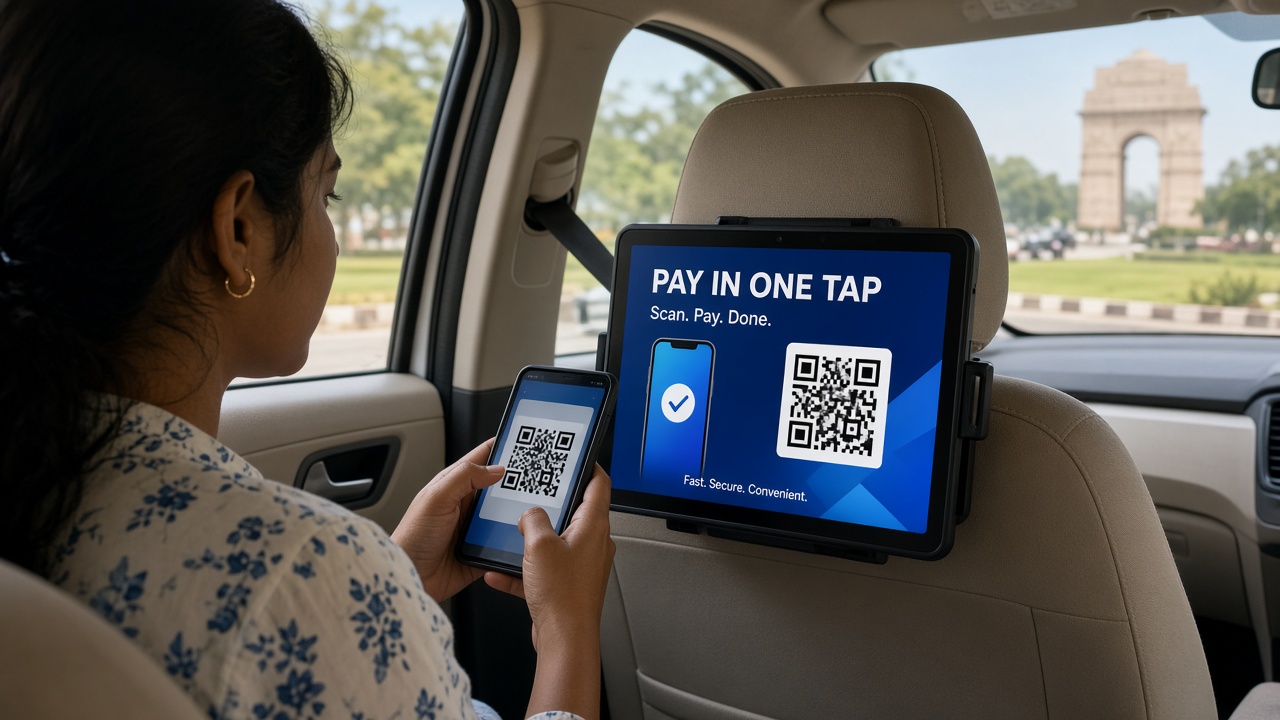
Direct answer. Hyper-local marketing reaches people by where they live, work and travel. Learn how to combine location-targeted digital ads with in-cab screens to own a city, a corridor or a neighbourhood.
Most "targeted advertising" lives on a screen in someone's hand. It knows what they searched, what they clicked and roughly where their phone is.
But your customer doesn't live in a feed. They commute through specific corridors, work in specific business districts, fly out of specific airports and shop on specific high streets. Hyper-local marketing is about reaching them there, in the physical places that tell you who they are.
This guide explains how hyper-local marketing works, which channels can actually do it in Indian cities, and how to build a campaign that owns a corridor instead of spreading thin across a country.
In this article
- What hyper-local marketing actually means
- Why place is a strong targeting signal
- The hyper-local toolkit
- How in-cab screens fit into hyper-local plans
- A 5-step hyper-local campaign plan
- Use cases by business type
- Measuring hyper-local results
- FAQs
What hyper-local marketing actually means
Hyper-local marketing focuses spend on a small, well-defined area: a city, a corridor, a business district or a neighbourhood. The audience is defined by where people physically are, not only by who they are online.
It's built on three ideas:
- Concentration beats coverage. Strong presence in one area builds more recall than thin presence everywhere.
- Place tells you about people. Someone on the airport road at 7 am, or in BKC at lunchtime, says a lot about their work, income and plans.
- Offline and online should reinforce each other. Seeing a brand on the street and then online makes it more familiar than either alone.
Why place is a strong targeting signal
Digital targeting relies on data trails: cookies, logins, app activity. Those signals are useful but noisy, and they are harder to collect than they used to be.
Physical location is simpler and harder to fake. In Indian metros, it maps closely to audience:
| Place | Who you're likely reaching |
|---|---|
| Airport routes | Business travellers and frequent flyers |
| BKC, Lower Parel, Nariman Point (Mumbai) | Finance, consulting and corporate professionals |
| Cyber City (Gurugram) | Corporate and multinational employees |
| Outer Ring Road and tech parks (Bengaluru) | IT and startup workforce |
| HITEC City and Gachibowli (Hyderabad) | Tech and enterprise professionals |
| Hinjewadi and Kharadi (Pune) | IT and services workforce |
| High streets and wholesale markets | Shoppers, traders, small business owners |
You aren't guessing someone's job from their browsing history. You're meeting them on the way to it.
The hyper-local toolkit
No single channel does hyper-local well alone. Here's what each option offers and where it falls short.
1. Location-targeted search and social
Platforms like Google Ads let you target countries, regions, cities, or a radius around a location. Google's location targeting documentation sets a minimum radius of 1 km. It also warns that very small targets may show ads only sometimes, or not at all.
- Good for: capturing local intent ("near me" searches) and retargeting
- Limit: location signals vary in accuracy, and you still compete in the auction for attention
2. Hoardings and static outdoor
- Good for: big, permanent presence at a landmark junction
- Limit: a glance, no response path, photo-based proof, high minimum commitments
3. Vehicle branding (wraps, autos, two-wheelers)
- Good for: moving visibility in dense lanes and markets
- Limit: seen in passing from the street, no interaction, vehicle-photo proof
4. In-cab digital screens
- Good for: long attention from one passenger in business and airport corridors, with a QR response path and GPS-logged proof
- Limit: you choose city and cab type rather than drawing a radius on a map (explained below)
The strongest plans combine 1 and 4: in-cab screens to create presence and explain the offer, and location-targeted digital to catch the search and retarget the visit.
How in-cab screens fit into hyper-local plans
Here's exactly how targeting works on Backseat Network today, so you can plan around it.
What you choose (how it works):
- City: Mumbai, Delhi NCR and Bengaluru are live. Hyderabad, Chennai and Pune are onboarding.
- Cab type: airport cabs (Innova and Ertiga) for premium reach, or city cabs (Swift and Dzire) for frequency.
- Number of cabs and number of months.
Where the fleets operate:
- Mumbai: airport T1 and T2, BKC, Lower Parel, Andheri and Powai, the Bandra-Worli Sea Link, Navi Mumbai and Nariman Point
- Delhi NCR: IGI Airport, Cyber City, Connaught Place and Noida
- Bengaluru: tech parks, airport runs and the Outer Ring Road
What you learn: reports show plays and reach by city and route, plus QR scans by creative. You can then move spend toward the best performers.
An honest note: the network doesn't currently offer neighbourhood or time-of-day targeting as a setting. You target the city and the fleet type, and the fleets themselves run in business districts and airport corridors. That's what makes the screens hyper-local in practice. Route-level reporting then shows you which corridors respond.
Beyond cabs, Backseat's fleet mix also includes two-wheelers in dense lanes and high-street junctions, tempos and vans around wholesale markets and last-mile routes, and trucks on national highways. Talk to the team about specs and availability for those.
A 5-step hyper-local campaign plan
Step 1: Pick one city and one audience
Choose where your customers are concentrated and where you can serve them, whether that's delivery coverage, a store, or a sales team that can follow up.
Step 2: Choose your fleet type by audience
- B2B, premium or travel-related: airport cabs
- Mass urban, repeat exposure, local services: city cabs
Step 3: Write locally
Hyper-local creative should feel local:
- Name the city or the area your customer recognises ("Working in BKC?")
- Use the language your customer reads first. Screens support Hindi, English or both.
- Make the offer local: a nearby store, a city-only discount, a same-day service area
Creative specs: silent landscape MP4 of about 15 seconds or a still image, up to 40 MB, about 6 to 14 words, one large QR code (specs).
Step 4: Wrap it in location-targeted digital
- Run search ads targeted to the same city to catch people searching your brand after seeing it
- Retarget QR-scan visitors on social
- Use the same headline across cab and digital so the message connects
Step 5: Start small, then concentrate
The minimum booking is one cab for one month at ₹4,000 plus GST, the same price in every city. A practical starter is 10 cabs for one month (₹47,200 including GST). After that, add cabs in the city that's working rather than spreading to new cities too early. For a full test design, see our budget framework in Outdoor Advertising vs Digital Ads.
Use cases by business type
| Business | Hyper-local play |
|---|---|
| Real estate project | City cabs in the project's city, with a QR code to book a site visit, plus radius-targeted search ads around the project |
| B2B SaaS or fintech | Airport cabs in one metro, a "Scan to book a demo" QR code, and LinkedIn retargeting of visitors |
| Restaurant chain or cloud kitchen | City cabs in delivery cities, a QR code for a first-order discount, and location-targeted app install ads |
| Clinic or diagnostics chain | City cabs where the centres are, a QR code to book an appointment, and "near me" search ads |
| Education and coaching | City cabs in tech and business corridors, a QR code to book a free demo class |
| D2C brand launching in a new city | City cabs, a city-specific discount code, and retargeting of scanners on social |
For airport-focused plans, read Planning an airport cab campaign in Mumbai.
Measuring hyper-local results
Hyper-local marketing is only as good as its measurement. Set up these four layers before launch:
- Delivery: GPS-logged plays and the live cab map in the Backseat console show where your ad actually ran.
- Response: put a UTM-tagged link behind every QR code, following Google Analytics' URL builder guidance. Add the city and creative to utm_content, for example utm_content=mumbai-bkc-v1.
- Conversion: track leads and sales from that source in your analytics and CRM. Use a city-specific discount code to catch purchases that happen later or offline.
- Local lift: compare branded search volume in the campaign city before and during the flight, and against a city where you didn't run.
That last comparison, campaign city against a city without the campaign, is the closest thing to a controlled test most brands can run in outdoor. Use it.
The bottom line
Hyper-local marketing isn't a smaller version of mass marketing. It's a different strategy: win a place, then expand.
In Indian metros, the places worth winning are the corridors where your customers spend their commute. Put your brand in the back seat on those routes, back it with location-targeted digital, and measure city against city.
Pick your city. Explore live cities, or price your first campaign.
FAQs
What is hyper-local marketing?
Hyper-local marketing focuses advertising on a small, well-defined geographic area, such as a city, business district, corridor or neighbourhood. It reaches people based on where they physically live, work and travel, often combining offline channels like in-cab screens with location-targeted digital ads.
Can I target a specific neighbourhood with in-cab ads?
On Backseat Network, you currently choose the city, the cab type, the number of cabs and the number of months. Neighbourhood and time-of-day targeting aren't settings today. The fleets operate in business districts and airport corridors, and reports show plays and reach by city and route.
How small an area can I target with Google Ads?
Google Ads allows radius targeting with a minimum radius of 1 km around a location. Google notes that very small targeting areas may show ads only intermittently or not at all.
What businesses benefit most from hyper-local advertising?
Businesses whose customers are concentrated in specific places: real estate projects, clinics, restaurants and cloud kitchens, coaching institutes, B2B companies targeting business districts, and D2C brands launching in a new city.
How do I measure a hyper-local campaign?
Track delivery with GPS-logged plays, response with UTM-tagged QR codes, and conversions in your analytics and CRM. Measure local lift by comparing branded search in the campaign city against the period before the campaign and against a similar city where you didn't advertise.
How much does a hyper-local in-cab campaign cost?
Backseat Network charges ₹4,000 per cab per month plus 18% GST, the same in every city. The minimum is one cab for one month. A 10-cab, one-month campaign in a single city costs ₹47,200 including GST.
Related reading
Put this on a cab this week
₹4,000 per cab per month plus GST. Build the ad yourself, or book a 15-minute demo.