Direct answer. Programmatic DOOH buys digital out-of-home screens through automated platforms. See how it works, how it differs from direct buys, and what it means in India.
Programmatic DOOH is the automated buying and selling of digital out-of-home screens through software, instead of booking each screen by hand with the media owner. The buyer sets the audience, budget and rules in a platform, and machines buy, serve and report the ad plays.
That short answer hides a lot of moving parts. This guide walks through how programmatic outdoor advertising works, how it differs from direct buying, and what Indian buyers should check before they treat it as the default. For the wider channel, start with our complete guide to DOOH advertising in India.
Key takeaways
- Programmatic DOOH automates how digital out-of-home screens are bought, usually through a demand-side platform talking to a supply-side platform.
- One play on a public screen can reach several people, so DOOH bids carry an impression multiplier instead of counting one impression per play.
- Programmatic adds speed and flexibility. It does not, by itself, make measurement better: proof of play still has to be checked.
- Direct and self-serve buying still suit specific inventory, such as in-cab screens, and smaller budgets.
- Before comparing prices across sellers, ask what each one counts as an "impression".
What is programmatic DOOH?
Start with the terms. OOH (out-of-home) is any advertising people see outside their homes, from hoardings to bus shelters. DOOH (digital out-of-home) is the digital part of it: screens on roadsides, in malls, at airports, in metro stations and inside cabs.
Programmatic means buying media through software using data and rules, rather than through emails, rate cards and signed release orders. Programmatic DOOH, often shortened to pDOOH, brings that web-style plumbing to physical screens.
How programmatic outdoor advertising works, step by step
Every programmatic DOOH buy runs through two pieces of software. A supply-side platform (SSP) represents the media owner and its screens. A demand-side platform (DSP) represents the buyer and its budget. Here is what happens between them.
- The media owner lists its screens. Each screen is described to the SSP: location, size, venue type and an audience estimate for each play.
- The buyer sets up a campaign in a DSP. Rules include target areas, dayparts (time windows such as 8 to 11 am), audience segments, budget and the maximum price per thousand impressions, known as CPM.
- A screen sends a bid request. When a slot is open, the SSP tells DSPs what is available, where it is, and how many people are likely to see that play.
- DSPs decide and bid. In real-time bidding (RTB), the highest eligible bid wins the slot within milliseconds. Some deals skip the auction and use a fixed price agreed in advance.
- The creative plays. The screen shows the winning ad and logs the play. That log is the proof of play: a record that the ad actually ran, when and where.
- The buyer gets a report. Impressions, spend and play logs flow back to the DSP, ideally checked by an independent verification partner.
The common language behind steps 3 and 4 is OpenRTB, a standard maintained by IAB Tech Lab. AdExchanger reported that the Tech Lab added DOOH-specific objects to OpenRTB so that SSPs and DSPs stopped building custom connections, and that DOOH transactions must now carry the screen's latitude and longitude.
Why DOOH needs an impression multiplier
A phone screen has one viewer. A billboard at a busy junction may have dozens during a single play. So in DOOH, an impression is not simply a count of plays.
The IAB guide explains that a multiplier is applied to each play, based on the average number of people in the screen's viewing area. On a rotating loop, each ad also gets its share of time. In the IAB's own example, a 60-second loop with six ads gives each ad one-sixth of the exposure.
In practice, the multiplier is a model, not a headcount. It is built from footfall, traffic counts, dwell time (how long people stay in front of the screen) and location data. Two sellers can quote the same CPM and mean very different things, depending on whose model sits behind the number.
Programmatic vs direct DOOH buying
Programmatic and direct are two ways to buy the same kind of media. The right one depends on how much control you need over inventory, price and timing.
| Programmatic DOOH | Direct DOOH (including self-serve) | |
|---|---|---|
| How you buy | Rules in a DSP; software buys individual plays | Book specific screens, vehicles or sites for set dates |
| Pricing unit | Usually CPM, after an impression multiplier | Fixed price per site, slot or vehicle per period |
| What an impression means | Modelled audience per play | Defined by each seller; ask for the definition |
| Changing the plan | Fast: adjust dayparts, budgets and creatives mid-flight | Depends on the seller and the contract |
| Inventory | Only screens connected to an SSP | Any screen the seller owns, including networks not on exchanges |
| Budget certainty | Spend paces against rules; delivery can vary | Total cost known before the campaign starts |
| Best for | Multi-network reach, daypart and trigger-based buys | Specific environments, fixed inventory, smaller or test budgets |
One honest caveat from the IAB guide: programmatic DOOH still lags other digital formats, and many DOOH platforms still run on fixed scheduling rather than real-time bidding. The guide also notes that fraud, such as inflated impressions or spoofed locations, is rarer than in web advertising but can still happen in automated buying. Automation is not the same as verification.
Where in-cab screens fit in programmatic outdoor advertising
In-cab advertising is a form of transit advertising: media in or on vehicles. Screens inside cabs are sometimes called CADOOH (cab digital out-of-home). If you are new to the format, our explainer on what in-cab advertising is in India covers the basics.
The IAB guide groups taxi and rideshare screens under interior moving DOOH. It notes these screens offer longer dwell time and can measure engagement through QR code scans, which is harder on a roadside billboard.
In-cab inventory also behaves differently from a billboard. Usually one or two passengers sit in front of the screen, at arm's length, for the whole ride. A multiplier built for a busy junction does not describe that audience well.
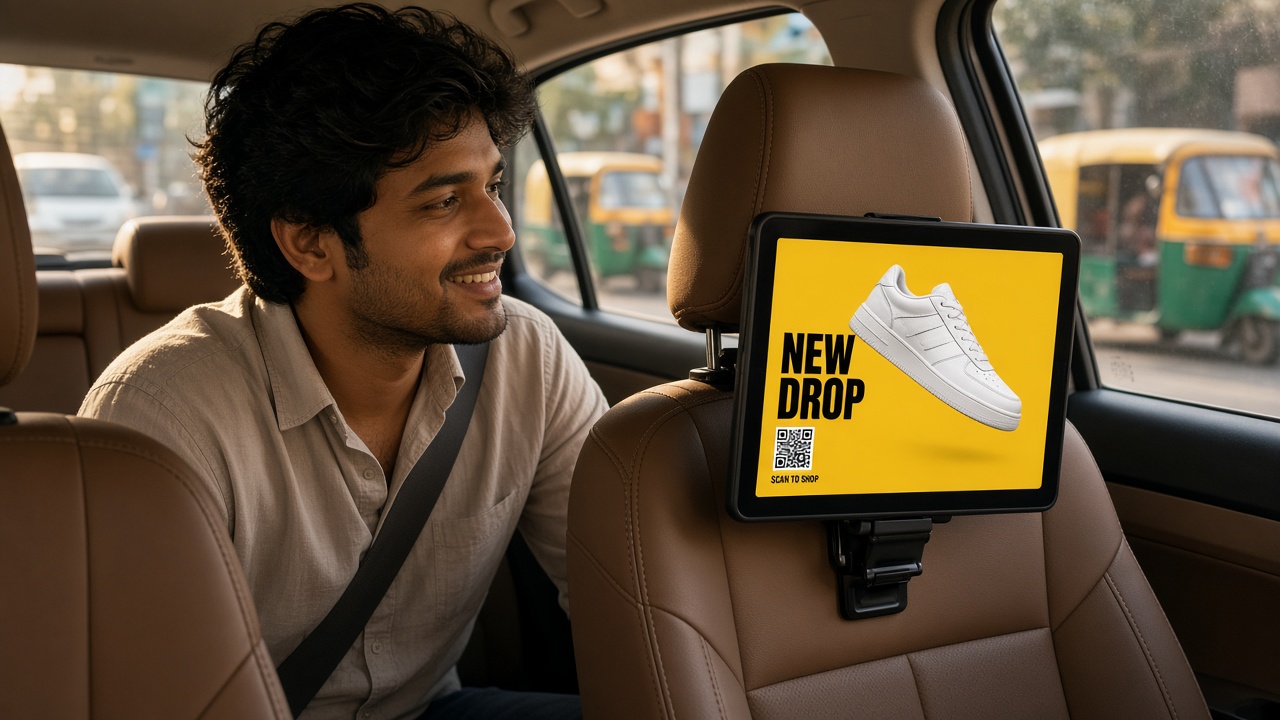
Backseat Network, for example, sells its in-cab screens directly rather than through programmatic exchanges. Silent tablets sit on cab headrests, about 60 cm from the passenger, with no skip button, for rides of 20 to 45 minutes in most cities. The step-by-step guide to how the network works shows the full flow from brief to report.
Pricing is per cab, not per modelled impression. Here is a worked example:
- 10 cabs × 1 month × ₹4,000 = ₹40,000
- GST at 18% = ₹7,200
- Total = ₹47,200
Impressions on this network are counted as playouts, not unique viewers. That is a narrower, more literal definition than a modelled multiplier, and it is worth knowing when you compare it with programmatic quotes.
Planning DOOH for clients? See how agencies can plan and book in-cab campaigns across Mumbai, Delhi NCR and Bengaluru.
Questions to ask before you buy programmatic DOOH
Use this checklist with any seller or platform, programmatic or direct.
- What counts as an impression? A play, an opportunity to see, a likelihood to see, or a modelled audience? The IAB guide separates all four.
- Where does the multiplier come from? Ask for the data source, the vendor and how recently it was updated.
- Is proof of play verified? Ask whether play logs are audited or checked by an independent partner.
- Can I see play logs by screen and time? You need this to match delivery with your own sales or search data.
- How fast can creative change? Programmatic should allow quick swaps; confirm the review time.
- What outcome can I track? Decide upfront whether success means QR scans, site visits, store visits or a brand survey.
For a closer look at how delivery is logged on in-cab screens, see how GPS-logged playouts and QR scans are measured. If your audience is business travellers, the playbook on planning an airport cab campaign in Mumbai shows how dwell time changes the plan.
Frequently asked questions
What does programmatic DOOH mean?
Programmatic DOOH means buying digital out-of-home screens through software instead of manual bookings. A buyer sets targeting, budget and price rules in a demand-side platform, and the platform buys individual plays on connected screens, often through real-time bidding. Reports then come back automatically, showing impressions, spend and proof that each ad played.
How is programmatic DOOH priced?
Programmatic DOOH is usually priced on CPM, the cost per thousand impressions. Because one play on a public screen can reach several people, each play is multiplied by an audience estimate before it is billed. That makes the multiplier as important as the CPM. Ask how it is calculated before comparing quotes from different sellers.
How is programmatic DOOH measured?
Programmatic DOOH is measured through play logs, modelled impressions and, where available, independent verification. The screen records each play, the seller applies an impression multiplier, and third parties can audit delivery. Outcome measures such as QR scans, store visits or brand lift surveys sit on top, and need their own set-up before the campaign starts.
What is the difference between DOOH and programmatic DOOH?
DOOH is the media itself: digital screens outside the home. Programmatic DOOH is one way of buying that media, through automated platforms. The same screen can often be bought either way. Direct buying fixes the screens, dates and price upfront, while programmatic buying lets software decide which plays to buy against your rules.
Can in-cab advertising be bought programmatically?
It depends on how each network chooses to sell its inventory, so ask the seller. Backseat Network sells its in-cab screens directly through a self-serve console at a fixed price per cab per month, so buyers know exactly which inventory and how many cabs they are paying for.
Is programmatic DOOH better than direct buying?
Neither is better in every case. Programmatic suits buyers who want flexible dayparts, frequent creative changes and one dashboard across many screen owners. Direct buying suits fixed inventory, specific environments and smaller budgets that need a predictable cost. Many planners use both, matching the buying method to the campaign goal rather than the other way round.
Conclusion: use programmatic DOOH where it fits the goal
Programmatic DOOH is a buying method, not a guarantee of better results. It shines when you want reach across many screen owners and the freedom to change plans mid-flight. Direct buying still wins when the environment itself is the point, such as a passenger sitting with your ad for a whole ride.
Whichever route you take, settle three things first: what an impression means, how delivery is proven, and which outcome you will track.
Planning in-cab media for a client? Book an Agency Demo and we will walk you through cities, cab counts and reporting.
Put this on a cab this week
₹4,000 per cab per month plus GST. Build the ad yourself, or book a 15-minute demo.