Direct answer. DOOH advertising in India explained: formats, costs, buying routes, measurement and rules, with 2025 market data and a checklist to plan your first campaign.
DOOH advertising in India means ads shown on digital screens outside the home, such as roadside displays, airport and metro screens, mall panels and in-cab tablets. Unlike printed hoardings, these screens can be scheduled, changed remotely and logged play by play.
This guide covers everything a brand or agency needs before spending on the channel: the market in numbers, the main formats, how buying and pricing work, how to measure results, what the creative needs, and the rules that apply. If you want the short version for one format first, read our explainer on what in-cab advertising is in India.
Key takeaways
- Indian advertising grew 13.5% to about ₹1.5 trillion in 2025, according to the FICCI-EY Media and Entertainment Report 2026.
- Out-of-home media grew 13% in 2025, and digital OOH made up 18% of OOH revenues, up from 7% in 2023.
- DOOH formats differ most on two things: how long people are in front of the screen, and how delivery is proven.
- You can buy DOOH directly, through self-serve platforms, or programmatically. Each suits a different budget and level of control.
- Measure in three layers: did it run, did people act, and did it change behaviour against a control.
What is DOOH advertising?
OOH (out-of-home) advertising is any advertising people see outside their homes. It includes hoardings, bus shelters, airport displays, transit media and in-store screens.
DOOH (digital out-of-home) is the screen-based part of OOH. The defining difference is control: a digital screen can show several ads in rotation, switch creative by time of day, and record each play.
Three terms come up in every DOOH plan, so define them early:
- Dwell time: how long a person stays in front of the screen. It decides how much your creative can say.
- Proof of play: the record that an ad actually played, when and where.
- Transit advertising: media in or on vehicles and transport hubs, including buses, metros, airports and cabs.
The DOOH market in India: what the 2025 numbers say
The most widely used annual benchmark for Indian media is the FICCI-EY Media and Entertainment Report. Its 2026 edition, published on 24 March 2026, covers calendar year 2025.
| Measure (India, 2025) | Figure |
|---|---|
| Total advertising revenue | About ₹1.5 trillion, up 13.5% |
| Digital advertising | ₹947 billion, 63% of all ad revenue, up 26% |
| E-commerce and point-of-sale ads | ₹220 billion, up 50% |
| Out-of-home media growth | Up 13%, led by premium properties and locations |
| Digital OOH share of OOH revenue | 18% (7% in 2023) |
| Linear TV advertising | Down 10% |
| Print advertising | Up 2% |
Source: FICCI-EY Media and Entertainment Report 2026, EY India press release, 24 March 2026.
Two points matter for planners. First, OOH is growing in line with the overall ad market, not shrinking. Second, the digital share of OOH more than doubled in two years, which means more screens can now be bought, changed and measured like digital media.
A summary of the same report by Social Samosa puts OOH revenue at ₹67 billion in 2025 and says about 30% of OOH revenue comes from transit media. Check both figures against the full report PDF before quoting them in a client deck.
Types of DOOH formats in India
DOOH is not one channel. A roadside LED and a cab tablet share a file format and little else. Compare formats on the viewing situation first, then on proof and response.
| Format | Typical setting | Viewing situation | Strength | Watch-out |
|---|---|---|---|---|
| Roadside digital billboards | Junctions, flyovers, arterial roads | Seconds, while moving | Large scale and visibility | Short exposure; ad shares a loop |
| Airport screens | Terminals, gates, baggage halls | Minutes, while waiting | Premium, travelling audience | Inventory can be costly and booked early |
| Metro and rail screens | Stations, concourses, coaches | Minutes, while commuting | Daily routine and frequency | Crowded, distracted environment |
| Malls and retail screens | Atriums, aisles, checkouts | Seconds to minutes, near purchase | Close to the point of sale | Many competing messages |
| Office and residential lift screens | Business parks, housing societies | Short but repeated | Repeated exposure to a defined audience | Very short moments per view |
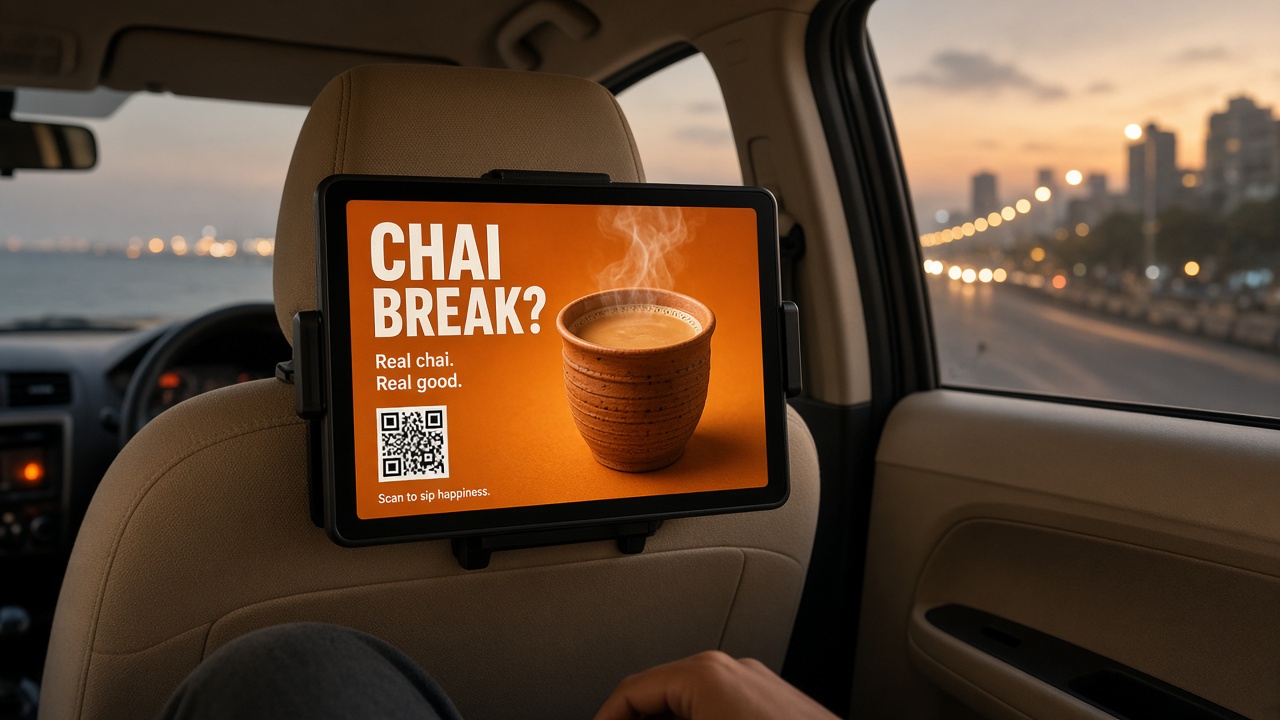
| In-cab screens (CADOOH) | Headrest tablets in cabs | 20 to 45 minutes per ride in most cities | One passenger, at arm's length, with a QR code to act on | Smaller reach per screen than a billboard |
CADOOH (cab digital out-of-home) is the in-cab part of DOOH. On Backseat Network, a silent tablet sits on the cab headrest, about 60 cm from the passenger, with no skip button. The network covers more than 15,000 cabs, with Mumbai, Delhi NCR and Bengaluru live and Hyderabad, Chennai and Pune onboarding. Each city page shows the routes and hotspots its fleet covers.
How DOOH advertising is bought in India
There are three main buying routes. Most brands end up using more than one.
- Direct from the media owner. You book specific sites, screens or vehicles for set dates at an agreed price. You get control over inventory and a known total cost.
- Self-serve platforms. You choose inventory, upload creative and pay online without a sales cycle. This suits smaller budgets, tests and fast launches.
- Programmatic DOOH. You set rules in a demand-side platform and software buys individual plays across connected screens, often through real-time bidding. Our guide to how programmatic DOOH works explains the mechanics and the trade-offs.
Agencies planning across several formats will find the DOOH media buying guide for agencies useful. It sets out a seven-step planning framework and a client reporting format.
What does DOOH advertising cost in India?
There is no single DOOH rate card. Price depends on the format, the city, the location, the time of year and how the inventory is sold. What you can compare is the pricing model, because each one tells you what you are actually paying for.
| Pricing model | What you pay for | Common in |
|---|---|---|
| Per site per period | A fixed screen or location for days, weeks or months | Roadside and airport screens |
| Per slot or loop share | A share of airtime in a rotating loop | Digital billboards and venue networks |
| CPM (cost per thousand impressions) | Modelled audience per play | Programmatic DOOH |
| Per vehicle per month | A screen in a vehicle for a calendar month | In-cab and transit networks |
Before comparing two quotes, ask what an impression means in each. One seller may count a play, another a modelled audience per play. The numbers are not comparable until the definition is.
Worked example: an in-cab DOOH plan
On Backseat Network, media is priced per cab: cabs × months × ₹4,000, plus 18% GST. Payment is by UPI, card or netbanking through Razorpay, and the GST invoice is emailed automatically.
| Plan | Media | GST at 18% | Total |
|---|---|---|---|
| 10 cabs × 1 month | ₹40,000 | ₹7,200 | ₹47,200 |
| 25 cabs × 1 month | ₹1,00,000 | ₹18,000 | ₹1,18,000 |
| 10 cabs × 3 months | ₹1,20,000 | ₹21,600 | ₹1,41,600 |
Impressions on this network are counted as playouts, not unique viewers. Keep that definition in mind when you compare it with a CPM quote from another format.
How to measure DOOH advertising performance
Measure DOOH in three layers. Each one answers a different question, and skipping the first two makes the third meaningless.
| Layer | Question | Typical evidence |
|---|---|---|
| Delivery | Did the ads run where and when we paid for? | Proof of play logs, screen uptime, location data |
| Response | Did people act? | QR scans, landing page visits, calls, coupon codes |
| Lift | Did behaviour or opinion change compared with people who did not see it? | Matched-city tests, branded search, sales data, brand surveys |
The IAB's July 2025 DOOH Measurement Guide recommends agreeing measurement with campaign goals before launch, using independent verification where available, and testing incrementality through matched markets or synthetic control groups. It also notes that screens inside taxis and public transit offer longer dwell time and can track engagement through QR scans.
On in-cab screens, delivery is logged per tablet with GPS, and QR scans are counted per creative. The page on how the network works end to end shows each step from brief to report. For the lift layer, our guide on how to measure OOH brand lift explains test and control designs that work on Indian budgets.
What makes DOOH creative work
DOOH creative is judged in the environment, not in the review meeting. Write for the distance, the dwell time and the sound setting.
- Short dwell, far away: one line, one image, the brand name. Roadside screens give you seconds.
- Long dwell, close up: room for a product demo and a call to action. In-cab and airport screens allow this.
- No sound: most DOOH screens play silently, so the message must work with no audio at all.
- A response path: a QR code with a clear instruction turns attention into a countable action.
- Language: Hindi and English versions, or regional languages, matched to the city and audience.
Our playbook for silent video ads covers these rules in detail, with a 15-second storyboard.
Rules and compliance for DOOH in India
- ASCI code. The Advertising Standards Council of India's code applies to everyone who commissions, creates, places or publishes ads in India. Ads must be honest, truthful, decent and fair in competition.
- Local permissions. Roadside and outdoor sites need approvals from local authorities, and rules differ by city. Check that your media owner holds valid permissions for every site.
- Data protection. If your QR landing page collects personal data, follow the Digital Personal Data Protection Act, 2023: clear notice, a stated purpose and consent.
- Category rules. Some categories, such as health, financial services and education, carry extra ASCI guidelines. Check them before the creative is final.
DOOH campaign planning checklist
- Write one objective and one primary KPI.
- Map your audience to places and moments in specific cities.
- Shortlist formats by dwell time and the response you need.
- Pick the buying route: direct, self-serve or programmatic.
- Agree what counts as an impression and how proof of play is shared.
- Brief creative for the screen, the distance and the sound setting.
- Record baseline data and choose a control city before launch.
- Launch, read results weekly, and move budget toward what works.
Planning a multi-city DOOH test? Book an Enterprise Demo to see how in-cab screens fit your plan.
Frequently asked questions
What is DOOH advertising?
DOOH, or digital out-of-home, advertising is advertising on digital screens outside the home, such as roadside displays, airport and metro screens, mall panels and in-cab tablets. Because the screens are digital, ads can be scheduled, changed remotely and logged play by play, which makes DOOH easier to manage and measure than printed hoardings.
What is the difference between OOH and DOOH?
OOH covers all advertising seen outside the home, including printed hoardings, bus shelters and wall paintings. DOOH is the digital, screen-based part of OOH. Digital screens can rotate several ads, change creative by time of day and record each play, while printed formats show one fixed message for the whole booking period.
How big is the DOOH market in India?
According to the FICCI-EY Media and Entertainment Report 2026, out-of-home media in India grew 13% in 2025, and digital OOH made up 18% of OOH revenues, up from 7% in 2023. Total Indian advertising grew 13.5% to about ₹1.5 trillion in the same year.
How much does DOOH advertising cost in India?
There is no single rate card. Cost depends on the format, city, location and pricing model, such as per site, per loop share, CPM or per vehicle per month. In-cab media on Backseat Network costs ₹4,000 per cab per month plus 18% GST, so ten cabs for one month total ₹47,200.
How is DOOH advertising measured?
DOOH is measured in three layers. Delivery uses proof of play logs showing when and where ads ran. Response uses actions such as QR scans and landing page visits. Lift compares behaviour or opinion in exposed and control groups, often through matched-city tests, branded search or brand surveys.
Can small businesses use DOOH advertising?
Yes. Self-serve platforms let small businesses choose inventory, upload creative and pay online without a long sales cycle. Start with one city, a short flight and one measurable action, such as QR scans to a dedicated offer page, then expand only where the results justify it.
Conclusion: plan DOOH advertising in India like a measurable channel
DOOH advertising in India is growing with the wider ad market, and its digital share is rising fast. The opportunity is real, but only for brands that plan it with the same discipline as digital media.
Choose formats by dwell time, agree what an impression means, put a response path on every creative, and test against a control. Do that, and outdoor stops being a line item taken on trust.
Ready to test DOOH with a measurable in-cab plan? Book an Enterprise Demo.
Put this on a cab this week
₹4,000 per cab per month plus GST. Build the ad yourself, or book a 15-minute demo.