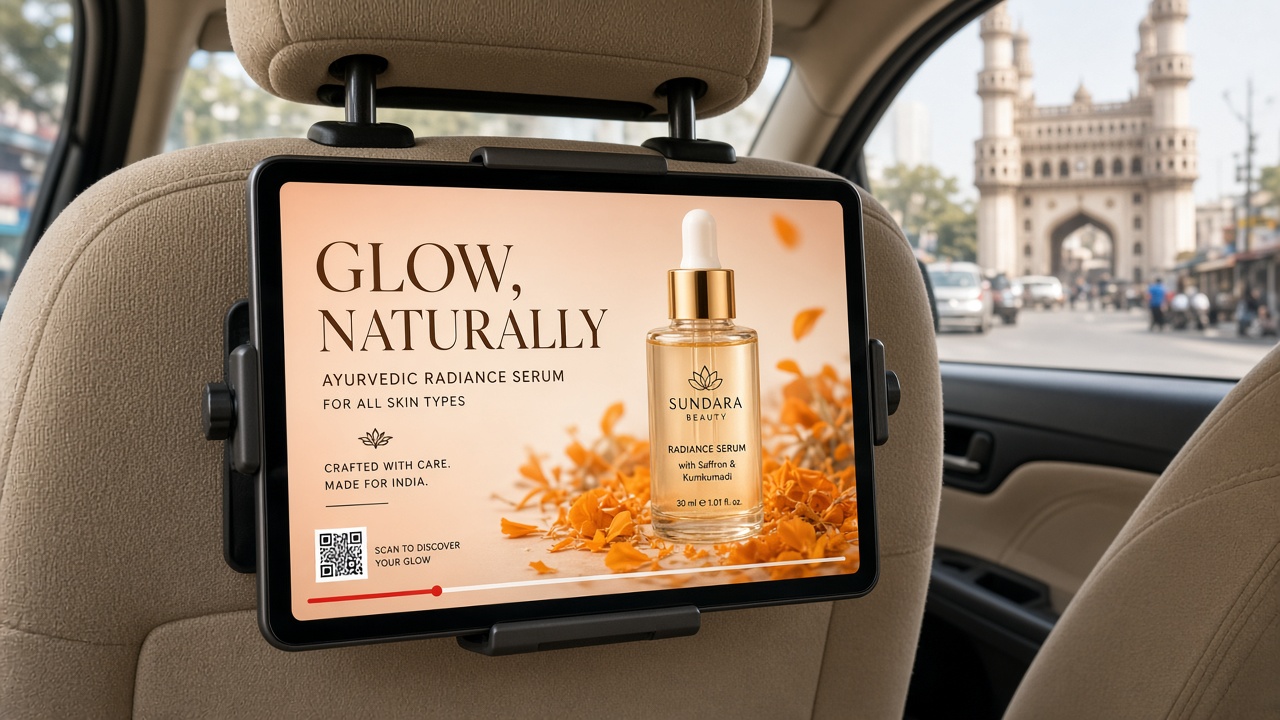
Direct answer. Silent video ads win when the message works with the sound off. A creative agency playbook for in-cab screens: hooks, type sizes, QR codes and Hindi copy.
High-converting silent video ads tell the whole story with pictures and on-screen words, show the brand early, and give the viewer one obvious action. On a screen with no audio, anything your voiceover says simply does not exist.
This playbook is for creative teams adapting work for silent screens, with in-cab tablets as the main example. For where these screens sit in the media mix, start with our complete guide to DOOH advertising in India.
Key takeaways
- Write for the eye. If the ad needs sound to make sense, it is not a silent ad yet.
- One message, one visual, one QR code, and type that reads in about two seconds.
- Put the brand on screen early. Late branding loses attribution even when the ad is noticed.
- Design the QR code as a hero element: large, high-contrast, with clear space around it.
- Make Hindi and English versions, then let QR scans decide which creative gets more screens.
What are silent video ads, and where do they run?
A silent video ad is a video built to work with no sound at all, through motion, images and on-screen text. It is a different job from adding subtitles to a TV commercial.
Silent placements are common in DOOH (digital out-of-home), the digital screens people see outside the home: lifts, malls, airports and transit. In-cab screens, also called CADOOH (cab digital out-of-home), are a clear case.
On Backseat Network, for example, a tablet sits on the back of the front-seat headrest, about 60 cm from the passenger. It plays with no audio and no skip button, for rides of 20 to 45 minutes in most cities. That changes the brief in two ways: the viewer is close enough to read detail, and will see your loop more than once.
The silent video ad framework: seven rules
- One message. Decide the single thing the viewer should remember. Cut every line that does not serve it.
- Brand in the first seconds. Google's Brand Lift guidance warns that when the brand is missing, late or too subtle, viewers do not attribute the ad back to it. It suggests adding branding earlier.
- Type that reads in two seconds. Use short lines, large sizes and strong contrast. If a line takes longer to read than it stays on screen, shorten the line, not the timing.
- Show, do not narrate. Let the product do something on screen: an app flow, a dish being served, a before and after. Motion carries meaning that words would otherwise need sound for.
- One QR code, designed in. Give it a fixed position, a clear call to action beside it ("Scan to book"), and enough time on screen to scan.
- Language for the audience. Produce Hindi and English versions where the audience needs both, rather than squeezing two languages into one frame.
- Loop-friendly endings. The last frame should hand back cleanly to the first. A viewer who joins mid-loop should still get the message.
Silent video ad specs for in-cab screens
Check the media owner's specs before production. For in-cab screens on our network, the brief looks like this.
| Element | Recommendation | Why it matters |
|---|---|---|
| File | Silent MP4, landscape | No audio track plays; the frame is landscape on the headrest tablet |
| Length | About 15 seconds | Short enough to loop many times in one ride |
| QR code | On the creative, in the same spot throughout or held in the closing seconds | The scan is the main response path |
| Text | Few words per frame; reads in about two seconds | The passenger glances, then looks again |
| Branding | Logo or name in the opening seconds and the end frame | Protects attribution when people catch the loop midway |
| Versions | Hindi and English | Matches the passenger, not the agency's default |
| Review | Every creative is reviewed before it goes live | Build review time into the launch plan |
If your client has no edit team, Vira, the network's AI assistant, can read a brand's website and draft Hindi and English copy and the landscape cab ad for the team to review. The step-by-step guide to how the network works shows where the creative check sits in the booking flow.
Designing the QR moment
In a silent ad, the QR code is the call to action, so treat it as part of the design, not a sticker added at the end.
- Size and contrast. Dark code on a light background, large enough to scan from the seat without leaning in.
- Clear space. QR codes need a quiet zone, a blank margin of at least four modules (the small squares) on every side. Keep text and graphics out of it.
- Error correction. DENSO WAVE, which created the QR code, defines four error correction levels, from L (about 7% recoverable) to H (about 30%). Use a higher level if you place a logo in the centre.
- Instruction beside it. "Scan to book a demo" beats a bare code. Say what happens after the scan.
- A landing page that keeps the promise. The page should load fast on mobile and match the ad word for word. A scan that lands on a generic homepage wastes the ride.
Test the final export on the real screen with at least three phones, in daylight and at night.
A 15-second storyboard for silent video ads
Use this as a starting structure, then adapt it to the product. Times are approximate.
| Seconds | What is on screen | Job |
|---|---|---|
| 0 to 3 | Brand name and the problem, in one short line | Hook and attribution |
| 3 to 8 | The product doing its job: one visual sequence | Proof without narration |
| 8 to 12 | The single benefit, in large type | The one thing to remember |
| 12 to 15 | QR code, instruction and brand end frame | Action, then a clean loop back |
For airport audiences, the story can carry more detail because rides are often longer. Our airport cab campaign checklist for Mumbai covers how that audience changes the creative.
Testing silent video ads and iterating
Silent video ads improve fastest when you test versions side by side. Run two or three creatives at once, each with its own QR code or landing page, and compare scans per creative.
On our network, QR scans are counted per creative and the best-performing creative can be rotated into more cabs while the campaign runs. New creatives are reviewed before they go live. To connect scans to wider results, such as branded search, see our guide on how to measure OOH brand lift.
Producing in-cab creative for clients? See how agencies plan and book in-cab campaigns, from brief to report.
Compliance check before you submit
Silent ads are still ads. The Advertising Standards Council of India's code applies to everyone who creates or places advertising in India, and requires ads to be honest, truthful, decent and fair in competition. Keep proof on file for every claim, number and comparison in the creative. Media planners can pair this playbook with our DOOH media buying guide for agencies.
Frequently asked questions
What is a silent video ad?
A silent video ad is a video designed to work with no sound at all. It carries the message through motion, images and short on-screen text instead of voiceover or music. Silent ads suit screens that play without audio, such as in-cab tablets, lift screens and many digital out-of-home displays.
How long should a silent video ad be?
Keep it short enough to loop cleanly and long enough to deliver one message and a call to action. For in-cab screens on Backseat Network, the creative is a silent landscape MP4 of about 15 seconds. Check each media owner's specs, because lengths and formats differ between networks.
How do you make a video ad work without sound?
Show the brand early, use one clear message, and let the product do something on screen rather than describing it. Keep on-screen text short, large and high-contrast so it reads in about two seconds. End with one obvious action, such as a QR code with a short instruction beside it.
How big should a QR code be on an in-cab screen?
Make it large enough to scan comfortably from the seat, keep strong contrast, and leave a clear margin around it. QR codes need a quiet zone of at least four modules on every side. Test the final file on the actual screen with several phones before the campaign goes live.
How much does it cost to run silent video ads in cabs?
On Backseat Network, media costs ₹4,000 per cab per month plus 18% GST. For example, 10 cabs for one month comes to ₹40,000 in media and ₹47,200 including GST. Production costs depend on your agency; Vira can also draft a first version of the ad from the brand's website.
How do you measure which silent video ad performs best?
Give each creative its own QR code or landing page, run versions at the same time, and compare scans per creative. On Backseat Network, QR scans are counted per creative and playouts are logged with GPS, so you can move more cabs behind the version that drives more scans.
Conclusion: silent video ads are built, not muted
The best silent video ads are designed for silence from the first frame: brand early, one message, type that reads at a glance, and a QR code that earns the scan. Treat the screen, the distance and the ride as the brief, and the creative does the converting.
Bringing silent creative to in-cab screens for a client? Book an Agency Demo.
Put this on a cab this week
₹4,000 per cab per month plus GST. Build the ad yourself, or book a 15-minute demo.