Direct answer. How to measure brand lift and out-of-home campaign performance in India: proof of play, QR scans, branded search and survey-based lift, explained step by step.
To measure brand lift from an out-of-home campaign, compare people or markets that saw the campaign with similar ones that did not, on the same brand question or behaviour. Everything else, from proof of play to QR scans, tells you whether the campaign ran and whether people responded, not whether it changed minds.
This guide separates those layers and shows how an Indian brand team can measure each one honestly. For the wider context on the channel, see our complete guide to DOOH advertising in India.
Key takeaways
- OOH performance has three layers: delivery (did it run), response (did people act) and lift (did it change what people think or do).
- Brand lift is an experiment: an exposed group against a control group, on the same question.
- Survey lift needs large samples. Google's own guidance needs roughly 1,200 to 2,800 responses to detect a lift above 4 points.
- For most OOH budgets, matched-city tests on branded search, enquiries or sales are more practical than surveys.
- Record baselines before launch. You cannot measure lift against a number you never captured.
What is brand lift in out-of-home advertising?
Brand lift is the change in a brand measure, such as awareness, ad recall, consideration or purchase intent, caused by advertising. It is measured by comparing an exposed group, who saw the ads, with a control group, who did not.
Out-of-home (OOH) advertising is any advertising seen outside the home, and DOOH is its digital, screen-based part. Measuring lift in OOH is harder than online, because you cannot tag a person who walked past a hoarding the way you tag a browser.
Google's Brand Lift measurement guide defines three common ways to express the result. Using its own example, where positive answers rise from 20% in the control group to 40% in the exposed group:
| Metric | How it is calculated | Result in the example |
|---|---|---|
| Absolute lift | Exposed rate minus control rate | 20 points |
| Relative lift | Absolute lift divided by the control rate | 100% |
| Headroom lift | Absolute lift divided by (1 minus the control rate) | 25% |
Always ask which one a report uses. A "100% lift" and a "20-point lift" can describe the same result.
The three layers of OOH campaign performance
Before you design a lift study, get the first two layers right. They are cheaper, faster and catch most problems.
| Layer | Question it answers | Typical metrics | Where the data comes from |
|---|---|---|---|
| Delivery | Did the ads run where and when we paid for? | Plays, screen uptime, locations, impressions | Media owner's proof of play logs; independent verification |
| Response | Did people act while or soon after seeing it? | QR scans, landing page visits, calls, coupon redemptions | Seller's scan counts; your own website and CRM data |
| Lift | Did it change what people think or do, compared with people who did not see it? | Survey lift, branded search lift, sales or footfall lift | Survey vendors, search data, sales data in test and control markets |
Proof of play is the record that an ad actually played, when and where. The IAB's July 2025 DOOH Measurement Guide recommends independent verification of delivery where available, and lists QR scans among the actions DOOH campaigns can track.
How to measure brand lift for an OOH campaign: six steps
- Write one hypothesis and one metric. For example: "Business travellers in Mumbai who see the campaign will search for our brand more than those in a comparable city." Pick awareness, recall, consideration, intent, branded search or sales. Not all of them.
- Choose the test design. The IAB guide recommends two approaches for incrementality: matched market tests, which run the campaign in test cities and keep similar control cities dark, and synthetic control, which models a comparison group. Pre and post surveys sit alongside these for awareness goals.
- Size the sample before you commit. Survey lift needs volume. Google's guidance needs about 1,200 to 2,800 responses to detect an absolute lift above 4%, and 20,000 to 45,000 to detect a 1% lift.
- Record baselines before launch. Capture at least four weeks of branded search, website visits, enquiries and sales in both test and control markets.
- Keep the control group clean. Do not run the same creative in control markets through other channels during the test. Google's guide warns that earlier exposure contaminates the control group and hides real lift.
- Read results with their uncertainty. Report the range, not just the headline number. "No lift detected" means no statistically significant difference was found, so check the sample size before deciding the campaign failed.
Why survey-based lift is hard for many OOH budgets
Survey lift works well when a platform can find thousands of exposed people and ask them a question. In OOH, finding exposed respondents usually means a panel or location data, which adds cost and time.
That is why many OOH lift studies use behaviour instead of opinion. The IAB guide describes matched market and matched store tests, which compare sales or visits between exposed and unexposed areas. For awareness goals, branded search volume in test versus control cities is a practical proxy that most brands already have access to.
Measuring in-cab campaign performance
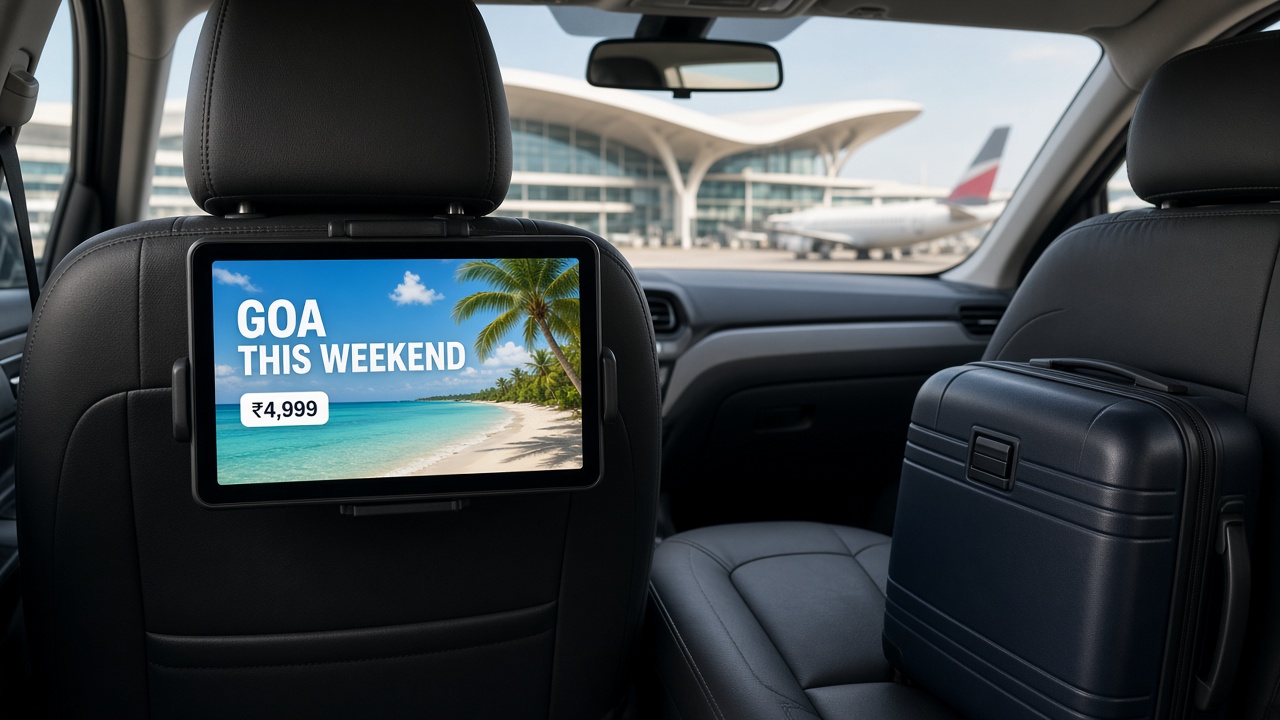
In-cab screens are a form of transit advertising, and they make the first two layers unusually clear. A passenger sits about 60 cm from the screen for a 20 to 45 minute ride in most cities, and a QR code on the creative turns attention into a countable action.
On Backseat Network, delivery and response are reported like this:
- Playouts: each tablet logs every play of your creative with its GPS position.
- Location: a live map in the console shows the cabs carrying your campaign, by city.
- Impressions: counted as playouts, not unique viewers.
- QR scans: counted per creative, so you can compare creatives on response.
The full method is on the page explaining how in-cab playouts and QR scans are measured. Brand lift is not part of that reporting. If you need it, run it as your own test using the steps above.
A practical design for a brand team looks like this. Run the campaign in one live city, such as Mumbai, Delhi NCR or Bengaluru, and keep a comparable city dark as the control. Compare branded search, direct website visits and enquiries in both cities against the baseline you recorded.
Price it with the standard formula: cabs × months × ₹4,000, plus 18% GST. For example:
- 25 cabs × 3 months × ₹4,000 = ₹3,00,000
- GST at 18% = ₹54,000
- Total = ₹3,54,000
Two cost ratios then become easy to report: cost per QR scan (media spend ÷ scans) and cost per incremental enquiry (media spend ÷ extra enquiries in the test city over the control).
Planning a measured test for a national brand? See how enterprise teams plan in-cab campaigns across cities.
Common mistakes when measuring OOH campaigns
- Reporting impressions as reach. Plays, modelled impressions and unique people are different numbers. Label which one you are showing.
- No baseline. Without pre-campaign numbers, any change after launch is a guess.
- Changing everything at once. Launching TV, social and OOH in the same week makes the OOH effect impossible to isolate.
- Weak creative, then blaming the channel. Google's lift guidance notes that creative quality plays a huge role in whether lift appears. Our playbook for silent video ads covers what works on screens with no sound.
- Reading one week of data. Branded search and enquiries move slowly. Set the reading window before launch.
If an agency runs your media, align them on these rules early. Our DOOH media buying guide for agencies sets out a reporting format both sides can use.
Frequently asked questions
What is brand lift in advertising?
Brand lift is the change in a brand measure, such as awareness, ad recall, consideration or purchase intent, that a campaign causes. It is measured by comparing people who saw the ads with a similar group who did not, using the same question. The gap between the two groups is the lift.
How do you measure the performance of an out-of-home campaign?
Measure it in three layers. Delivery shows whether the ads ran, through proof of play logs. Response shows whether people acted, through QR scans, landing page visits or calls. Lift shows whether the campaign changed behaviour or opinion, by comparing test markets or exposed people with a control group that did not see it.
How many survey responses does a brand lift study need?
It depends on how small a change you want to detect. Google's Display and Video 360 guidance needs roughly 1,200 to 2,800 responses to detect an absolute lift above 4%, and 20,000 to 45,000 responses for a 1% lift. Smaller expected effects need far larger samples.
Can you measure brand lift without a survey?
Yes. Matched market tests compare branded search, website visits, enquiries or sales in cities where the campaign ran against similar cities where it did not. Pre and post comparisons against a recorded baseline add context. These methods measure behaviour rather than opinion, and they use data most brands already collect.
How is in-cab advertising measured?
On Backseat Network, each tablet logs every play with its GPS position, and the console shows where and when the ad ran. QR scans on each creative are counted, and impressions are counted as playouts, not unique viewers. Brand lift, if needed, is measured separately by the advertiser using test and control markets.
How much does an in-cab campaign cost to test in India?
On Backseat Network, media costs ₹4,000 per cab per month plus 18% GST. A test of 25 cabs for three months comes to ₹3,00,000 in media, ₹54,000 GST and ₹3,54,000 in total. For a matched market test, you also need a comparable control city where the campaign does not run.
Conclusion: measure brand lift only after delivery and response are solid
To measure brand lift well, start with the basics: verified delivery, a countable response and a recorded baseline. Then pick one metric and one test design, and keep the control clean.
For most OOH budgets, matched-city tests on branded search and enquiries will tell you more than an underpowered survey. Either way, you will know what the campaign did, not just that it ran.
Want a measured in-cab test for your brand? Book an Enterprise Demo.
Put this on a cab this week
₹4,000 per cab per month plus GST. Build the ad yourself, or book a 15-minute demo.