Direct answer. How to launch an advertising campaign in India, step by step: goals, budget, channels, creative, compliance, tracking and the first 30 days after launch.
To launch an advertising campaign in India, set one business goal, work out what a customer is worth, pick the few channels that reach that customer, and set up tracking before you spend a rupee. Then launch small, read results weekly and scale only what works.
This blueprint breaks that into ten steps, with a launch timeline and a worked example. It suits a first campaign for a local business or a D2C brand, and works as a checklist for experienced teams. For the bigger channel picture, see our complete guide to DOOH advertising in India.
Key takeaways
- Start with one goal and one KPI. Every later decision depends on it.
- Set your budget from customer value: what you can afford to pay to win one customer.
- Choose two or three channels with clear jobs, not every channel at once.
- Set up tracking and record a baseline before launch, or you will not know what worked.
- Launch with a test budget, review weekly, and scale what proves itself in the first 30 days.
The 10-step blueprint to launch an advertising campaign in India
Step 1: Define one business goal and one KPI
Write the goal as a business result, not a media result. "200 new trial sign-ups in Pune in 60 days" is a goal. "Increase awareness" is not, until you say how you will measure it.
A KPI (key performance indicator) is the single number that tells you whether the goal was met. Pick one primary KPI and at most two supporting ones.
Step 2: Define your customer: who, where and when
Describe the customer in concrete terms: their city and neighbourhood, their routine, the language they read, and the moment they are most likely to need you. A founder in an airport cab, a parent outside a school and a shopper in a mall need different channels and different messages.
Step 3: Set the budget from customer value
Work backwards. Estimate what one customer is worth over time, decide what share of that you can spend to win them, and multiply by the number of customers you need.
Then split the budget in two: a main budget for channels you trust, and a test budget for channels you have not proven yet. The test budget is how you find better channels without betting the business.
Step 4: Choose the right channels
Match channels to the goal and the customer, not to habit. Search and e-commerce ads catch people already looking. Social, video and outdoor create demand. Local radio, print and outdoor suit footfall goals.
Our guide to types of advertising and how to compare their ROI explains how to pick and test channels fairly.
Step 5: Build the offer and one core message
Decide what you are offering and why it matters to this customer now. Then write one sentence that says it. Every ad, in every channel, should be a version of that sentence.
Step 6: Produce creative for each channel
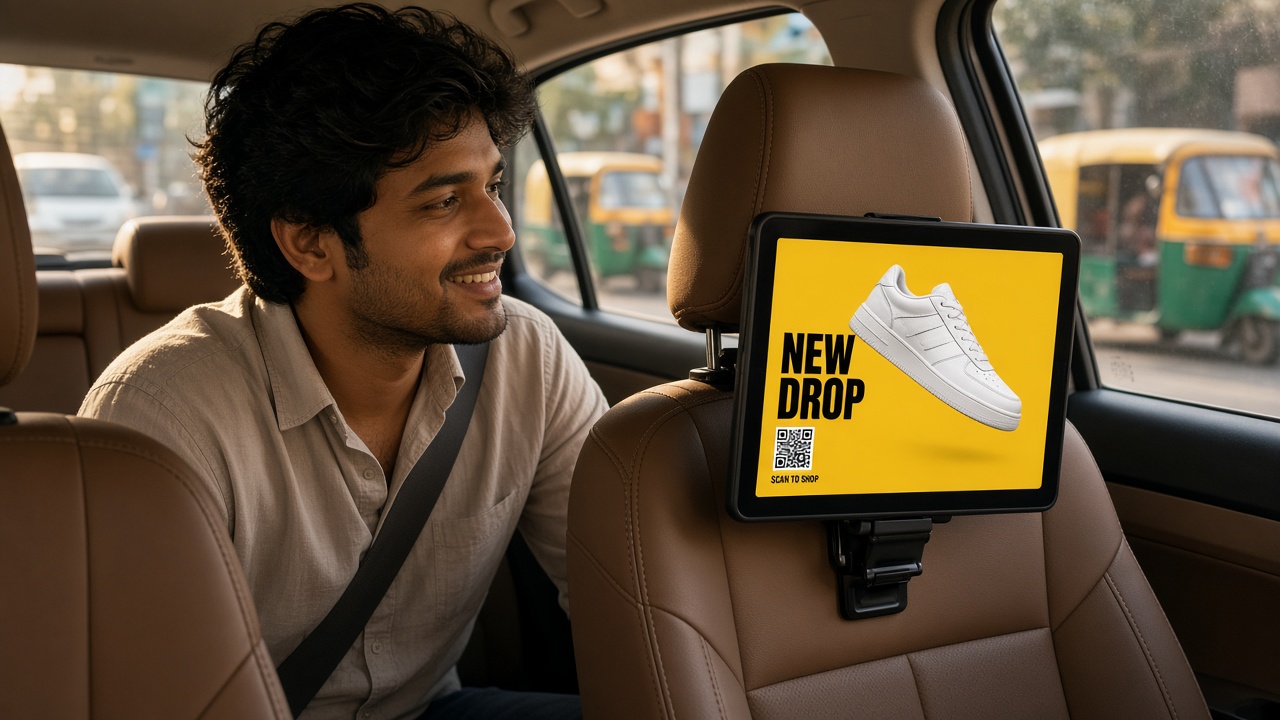
Adapt the core message to each format: the screen size, the viewing distance, the time people spend with it, and whether there is sound. Many screens outside the home play silently, so the message has to work without audio. Our playbook for silent video ads covers this in detail.
Plan Hindi, English or regional language versions to match the city and audience.
Step 7: Set up tracking before launch
Give every channel a way to be counted:
- A dedicated landing page or offer page per channel.
- A QR code on outdoor and print creative, linked to that page.
- A separate phone number or coupon code where people call or visit.
- A baseline: at least a few weeks of current sales, enquiries and branded search.
Step 8: Check compliance
- Advertising standards: the Advertising Standards Council of India's code requires ads to be honest, truthful, decent and fair in competition. Keep proof for every claim.
- Personal data: if your landing page collects names or numbers, follow the Digital Personal Data Protection Act, 2023, with a clear notice and consent.
- Platform and media owner rules: most networks review creative before it goes live. Leave time for it.
- Invoices: make sure every media purchase comes with a proper GST invoice for your accounts.
Step 9: Launch small, then scale
Run a first flight with part of the budget, in one city or one audience. Compare it against the baseline or a similar city where you did not advertise. Scale only what beats the baseline.
Step 10: Report weekly and review at 30 days
Each week, check delivery (did the ads run), response (scans, visits, calls) and results (sales, leads). At day 30, move budget away from what is not working and into what is. Our guide on how to measure OOH brand lift shows simple test and control designs.
A practical launch timeline
Most first campaigns need about four weeks of preparation. Use this as a planning sequence and adjust it to your channels.
| When | What to finish | Output |
|---|---|---|
| Week −4 | Goal, KPI, customer profile, budget | One-page brief |
| Week −3 | Channel choice and media bookings | Media plan with costs |
| Week −2 | Offer, core message, creative production | Approved creatives in every language version |
| Week −1 | Landing pages, QR codes, phone numbers, baseline data, compliance checks | Tracking sheet and baseline report |
| Weeks 1 to 4 | Launch, weekly reviews | Weekly report: delivery, response, results |
| Day 30 | Review and reallocate | Decision: scale, change or stop each channel |
Worked example: launching an in-cab campaign
Here is how the blueprint looks for a local business adding an outdoor channel with a measurable response path. On Backseat Network, a self-serve campaign runs in these steps:
- Brief Vira. Paste the business website into Vira, the network's AI assistant, which drafts Hindi and English copy and the landscape cab ad. Or upload your own silent MP4 with a QR code.
- Review the creative. Edit any line and approve it. Every creative is reviewed before it goes live.
- Choose the city, cabs and months. Mumbai, Delhi NCR and Bengaluru are live; Hyderabad, Chennai and Pune are onboarding.
- Pay online. UPI, card or netbanking through Razorpay, with the GST invoice emailed automatically.
- Go live and track. The operations team activates the screens. Playouts are logged with GPS and QR scans are counted per creative.
The budget follows a simple formula: cabs × months × ₹4,000, plus 18% GST.
| Plan | Media | GST at 18% | Total |
|---|---|---|---|
| 10 cabs × 1 month | ₹40,000 | ₹7,200 | ₹47,200 |
| 25 cabs × 1 month | ₹1,00,000 | ₹18,000 | ₹1,18,000 |
The step-by-step guide to how the network works shows what happens at each stage.
Running a local business? See how local businesses use in-cab screens to reach customers on their daily rides.
Common mistakes when launching a campaign
- Too many channels at once. You cannot learn what worked if five channels launch on the same day.
- No baseline. Without pre-launch numbers, every result is a guess.
- One creative for every format. A TV edit on a silent screen wastes the slot.
- Judging too early or too late. Read weekly, decide at 30 days, not at day 3 or day 90.
- Spending the whole budget in the first flight. Keep money back for the channels that prove themselves.
Frequently asked questions
How do I launch an advertising campaign in India?
Start with one business goal and one KPI, define your customer, and set a budget from what a customer is worth. Choose two or three channels with clear jobs, produce creative for each format, set up tracking and a baseline, check compliance, then launch small and scale what works after a 30-day review.
How much does it cost to run an advertising campaign in India?
Cost depends on the channels, cities and duration. Work backwards from customer value to set a budget, and keep part of it for testing. As one example, in-cab media on Backseat Network costs ₹4,000 per cab per month plus 18% GST, so 10 cabs for a month totals ₹47,200.
How long does it take to launch an ad campaign?
Most first campaigns need about four weeks of preparation: a week each for the brief and budget, channel bookings, creative production, and tracking and compliance checks. Self-serve channels can go live faster once creative is approved, but the planning steps still decide whether the campaign can be measured.
Which advertising channel is best for a small business in India?
The best channel is the one that reaches your customer where they are, at a cost your margins can carry. Local search and maps suit people already looking. Social and outdoor create awareness nearby. Test two or three channels with separate tracking, and keep the ones that beat your baseline.
How do I measure if my ad campaign worked?
Measure delivery, response and results. Check that ads ran as booked, count responses such as QR scans, calls and landing page visits, and compare sales or enquiries with your pre-launch baseline or a similar area where you did not advertise. The gap against the baseline shows what the campaign added.
Do ads in India need approval before they run?
There is no single approval for all ads, but the ASCI code applies to advertising in India, and many media owners and platforms review creative before it goes live. Some categories carry extra guidelines. Keep proof for every claim and leave review time in your launch plan.
Conclusion: launch an advertising campaign you can learn from
The best way to launch an advertising campaign in India is to treat the first month as a structured test. One goal, a budget tied to customer value, a few channels with clear jobs, tracking in place before launch, and a firm 30-day review.
Do that, and your second campaign starts with evidence instead of guesses.
Ready to test a measurable outdoor channel? Start a self-serve campaign.
Put this on a cab this week
₹4,000 per cab per month plus GST. Build the ad yourself, or book a 15-minute demo.