Direct answer. How to plan outdoor media across Gurugram, Noida, IGI Airport and central Delhi, and why captive in-cab screens beat a three-second hoarding glance.
Delhi NCR is one of the most lucrative, yet complex, media markets in the world. With a sprawling geography encompassing New Delhi, Gurugram, and Noida, the region sees millions of daily commuters navigating a mix of expressways, arterial ring roads, and frequent traffic bottlenecks.
For brands and advertising agencies in Delhi, allocating an outdoor marketing budget requires more than just picking a busy intersection. It demands a deep understanding of commuter psychology, route demographics, and the shift from traditional static billboards to measurable Digital Out-of-Home (DOOH) advertising.
In this comprehensive guide, we break down how to build a high-ROI outdoor media strategy in Delhi NCR, focusing on high-traffic corridors, executive commutes, and how to protect your marketing spend from vanity metrics.
The Geography of Commuting in Delhi NCR
To execute a successful outdoor advertising campaign in the National Capital Region, media buyers must segment the map based on audience intent and commuter flow.
1. The Corporate Corridor: Gurugram (NH-8 & Golf Course Road)
Gurugram is the financial and technology hub of the NCR.
Target Audience: CXOs, tech executives, B2B decision-makers, and high-net-worth individuals (HNIs).
Key Routes: The Delhi-Gurgaon Expressway (NH-8), Cyber City road networks, and Golf Course Extension.
Media Strategy: Commutes here are long and often stationary due to peak-hour traffic. Media placements should cater to B2B tech marketing, luxury real estate, and premium automotive brands. High dwell time is the primary metric here.
2. The Tech & Real Estate Hub: Noida (DND Flyway & Noida Expressway)
Noida and Greater Noida have evolved into massive hubs for IT parks, manufacturing, and sprawling residential townships.
Target Audience: IT professionals, young families, and real estate investors.
Key Routes: The DND Flyway, Noida-Greater Noida Expressway, and Sector 62/132 intersections.
Media Strategy: This route is ideal for D2C brands, educational institutions, and affordable-to-mid-segment real estate. Commuters on expressways move faster, meaning ad creatives must be highly legible with bold, instant messaging.
3. The Premium Transit Hub: IGI Airport & Aerocity
The Indira Gandhi International (IGI) Airport route captures the most premium transient audience in the country.
Target Audience: International travelers, domestic business travelers, and NRIs.
Key Routes: Terminal 3 approach roads, Aerocity hospitality district, and the Airport Express Line corridor.
Media Strategy: Brands seeking international prestige or targeting affluent tourists thrive here. However, traditional static hoardings near the airport are notoriously expensive, requiring media planners to look for smarter transit alternatives.
4. The Retail & Lifestyle Core: South & Central Delhi
Areas like Connaught Place (CP), South Extension, and Vasant Kunj represent the retail heart of the city.
Target Audience: Shoppers, students, and local residents.
Key Routes: Outer Ring Road, Inner Ring Road, and Aurobindo Marg.
Media Strategy: Hyper-local targeting works best here. A digital marketing agency in Gurugram or Delhi will often use geo-fenced mobile ads combined with local DOOH screens to drive immediate footfall to nearby retail stores and restaurants.
Traditional Hoardings vs. The DOOH Evolution
For decades, the default NCR media strategy was buying massive hoardings on the Ring Road. However, modern media buyers are pivoting to DOOH advertising for several critical reasons:
Ad Blindness & Speed: A billboard on the DND Flyway might see 100,000 cars a day, but at 80 km/h, the actual viewable time is under 3 seconds.
Lack of Attribution: You cannot confidently track how many people looked at a static billboard, making it difficult to calculate true Return on Ad Spend (ROAS).
Cost Inefficiency: Premium NCR hoardings can cost upwards of ₹5 Lakhs to ₹15 Lakhs a month—a massive risk for any brand's marketing budget.
How Backseat Network Solves the Delhi NCR Commute Puzzle
At Backseat Network, we looked at the agonizing 45 to 90-minute commute across Delhi NCR not as a problem, but as the ultimate media opportunity.
Instead of fighting for 3 seconds of attention on a crowded highway, we bring the screen directly inside the vehicle. Here is how our programmatic in-cab DOOH platform serves brands in the NCR:
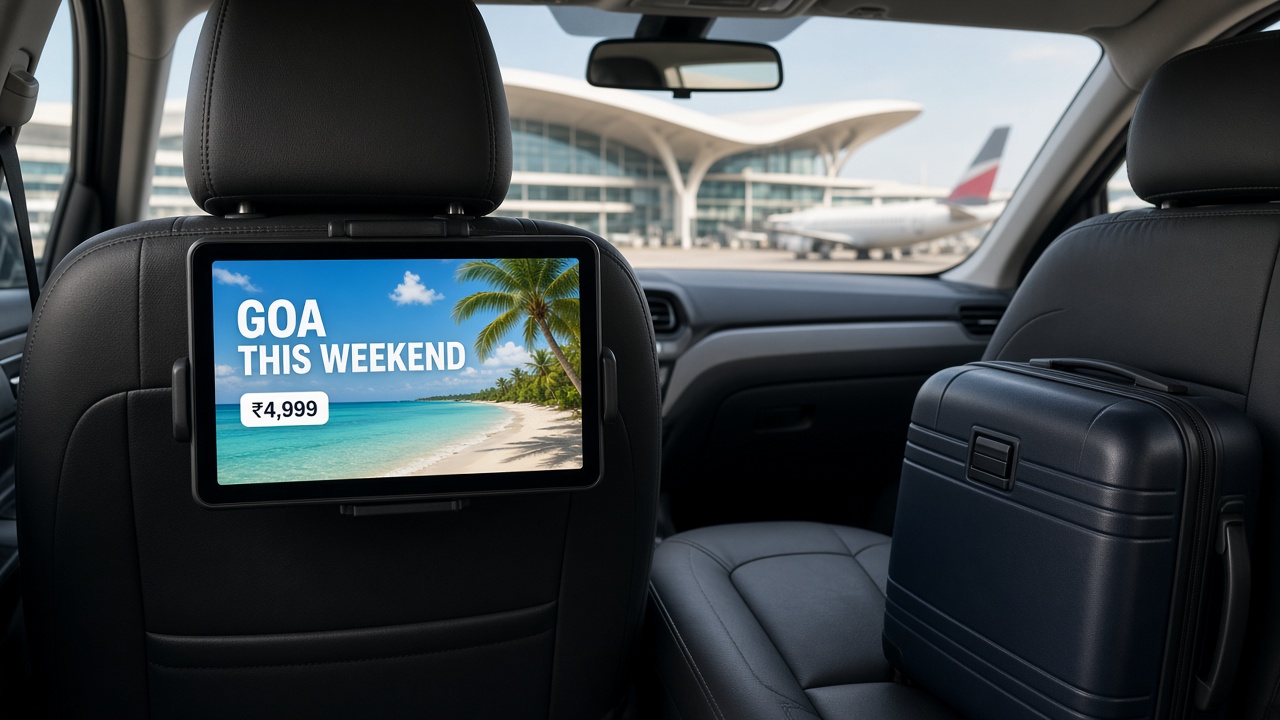
Unskippable Executive Commutes: We place high-definition digital screens in the backseats of premium airport cabs (Innovas/Ertigas) and city taxis (Swifts/Dzires). When an executive is stuck in traffic on NH-8, your brand has their undivided attention for an average of 30+ minutes.
Scan-to-Act Attribution: Every ad features a dynamic QR code. A passive ride from Noida to CP turns into a trackable website visit, app install, or lead generation event.
Transparent Pricing: We bypass the opaque pricing of traditional Delhi advertising agencies. We charge a flat, transparent ₹4,000 per cab, per month.
Live GPS Tracking: Our dashboard shows you exactly where your ads are playing across the NCR map in real-time, offering unprecedented proof of play.
Crafting Your Executive Commute Strategy (Expert Pointers)
If you are planning an outdoor media rollout in Delhi NCR, follow these E-E-A-T backed principles to protect your budget and maximize impact:
Prioritize Dwell Time over Gross Impressions: 1,000 captive views for 15 seconds are infinitely more valuable than 100,000 blurry, 1-second glances.
Bridge the Offline-to-Online Gap: Never run an outdoor ad without a digital bridge (a QR code, a specific search term, or a custom promo code).
Target the Transit, Not Just the Destination: The modern executive spends up to 2 hours a day in transit. Media that travels with them (like cab screens) offers a higher frequency of messaging.
Frequently Asked Questions (FAQs)
1. What is the most effective outdoor advertising route in Delhi NCR?
It depends on your audience. The Delhi-Gurgaon Expressway (NH-8) is best for B2B and corporate targeting, the DND Flyway is excellent for tech and real estate, and the IGI Airport route is unmatched for premium/luxury brands.
2. How much does outdoor advertising cost in Delhi?
Static billboards in prime NCR locations can range from ₹2 Lakhs to ₹20 Lakhs per month. Alternatively, transit DOOH platforms like Backseat Network offer hyper-targeted in-cab screens for a flat ₹4,000 per vehicle per month.
3. What is DOOH and why is it replacing static billboards?
DOOH (Digital Out-of-Home) utilizes digital screens rather than printed flex. It is replacing static billboards because it allows for multiple creatives, day-parting (showing different ads in the morning vs. night), and better data measurement.
4. How can B2B brands advertise effectively in Gurugram?
B2B brands should focus on the "executive commute." Instead of broad highway billboards, targeting business professionals during their 45-minute cab rides to Cyber City provides the dwell time necessary to explain complex B2B value propositions.
5. How do I measure the ROI of my outdoor campaign in Delhi?
Modern DOOH campaigns should be measured using QR code scans (tagged with UTM parameters), live GPS playout reports, and correlated spikes in direct website traffic from the targeted geographic area.
6. Can a small business afford outdoor advertising in Delhi NCR?
Yes. While massive hoardings are out of reach, programmatic DOOH allows local businesses to book small fleets of cabs (e.g., 10 cabs for ₹40,000/month) that circulate within their specific target radius.
7. Why is dwell time important in NCR traffic?
Delhi NCR is famous for its traffic jams. Dwell time refers to how long a consumer is exposed to your ad. High dwell time environments (like the inside of a cab) allow brands to use longer copy and drive actual conversions, rather than just basic brand awareness.
8. Should I hire an advertising agency in Delhi for media buying?
Working with an agency can help with creative strategy and omnichannel planning.
Put this on a cab this week
₹4,000 per cab per month plus GST. Build the ad yourself, or book a 15-minute demo.